


The key takeaways
-
The staked ETH has increased significantly. There are now nearly one million validators, and 30% is being staked. Operational complexity prevents many institutions, in spite of the possible yield, from directly participating.
-
Developers have been working on “one-click staking,” In order to deploy validators on automated systems that are standardized, institutions do not need deep technical skills.
-
DVT-lite has been a major enabler in this transition. DVT allows multiple nodes (or validators) to work together on a single validator.
-
The implementation of one-click staking can drive adoption by institutions, improve network resilience, and strengthen the validityator community.
Ethereum’s Proof-of Stake (PoS framework) has evolved into a central part of Decentralized Finance (DeFi). The landmark switch from Proof-of-Work (PoW), which was implemented during the Ethereum network’s launch, has become a core part of DeFi. the 2022 MergeThe participation of validators has significantly increased since a major upgrade to the software that removed energy-intensive mining.
As Ethereum’s co-founder, Vitalik Buterin has suggestedThere is still a major barrier. Staking remains prohibitively complex for retail players and large institutions.
In order to bridge the gap, engineers explore ways of streamlining validator setup. They are working towards a user-friendly experience that is one click. This initiative is using “DVT-lite” The use of a simplified distributed validater technology would enable organizations to manage their nodes, without the need for technical expertise.
The article explores the reasons why Ethereum developers want to implement one-click stake for validators, in order to reduce intermediaries and enhance decentralization, as well as unlock wider validator participation.
Ethereum’s new institutional stake experience
Ethereum has re-examined the stake user experience for institutions, because despite a significant increase in participation, many major players are still reluctant to directly engage due to technical hurdles.
EtherETHStaking has grown significantly in the last few years. By early 2026, the following will be true:
-
Approximately The stakes are between 37 and 38 Million Ether.
-
The circulating stock is approximately 30%-32%.
-
The network has now grown to include nearly 1 million validators.
-
The average yield from base stakes is between 2 and 3 percent per annum.
The figures show the increasing maturity of an ecosystem. But the stake ratio suggests that further growth is possible.
Larger organizations like crypto funds, Fintech firms and Corporations holding Ether as part of their portfolios tend to shy away from direct speculating. Deterrents are less about the possible rewards than the operational complexity involved.
The direct validation operation usually requires that:
-
Detail infrastructure planning and setup
-
Robust Key Management Protocols
-
Updating and maintaining the Validator client on a regular basis
-
Continuous monitoring of uptime
-
Risk assessment is important to avoid slashing of penalties.
These technical and continuing responsibilities can seem overly burdensome to institutions used to the traditional streamlined finance processes. They may also be out of sync with standard operating procedures.
Did you Know? It is not surprising that the origins of this technology are similar to multi-signature walletsControl is distributed among participants. Instead of depending on one keyholder, many nodes collaborate, which reduces the risk associated with a single point failure.
One-click stake means
The following is a list of the most recent and relevant articles. Buterin refers to one-click stakinghe is referring to the simple deployment of native validators and not earning products from centralized exchanges.
It is intended to simplify the operation of direct validators for institutions. This model would require an institution to:
-
You will need to select the servers or computers that you want the nodes validator running on.
-
Create a configuration that contains shared details of validators, like a key common to all nodes.
-
Launch a standard, containerized installation.
When the system is activated, it will manage automatically:
Buterin proposes using Docker images, Nix containers, or other standard formats. It would be possible for node operators, using a simple click on the node or command to each node, to deploy validators in a similar way as modern cloud apps.
The staking operation would become more of a standard software application than an specialized blockchain.
Validators: Why they still scare institutions
Ethereum’s existing validator set-up continues to discourage many institutions, in spite of the protocol’s focus on security and centralization. The main reason is its technical complexity.
Managing several software components is required to operate a validator:
-
Consensus clients: Beacon Chain logic, validation duties, and network consensus
-
Clients: Execute and process transactions smart contracts Maintenance of the Ethereum Virtual Machine (EVM) The state of affairs
-
Validator clients Block proposal and attestation duties are performed on the consensus layer
-
Safe key storage systems Protect validator signing keys
The institution must be prepared to deal with a number of operational risks.
-
Slashing penalties: Double-signatures or other misbehaviors can cause losses.
-
Downtime penalties: When validators are unable to verify or suggest blocks, this can lead to reduced rewards or inactivity.
-
Cyber security vulnerabilities Especially those that involve the compromise or exposure of private validator keys
Even large organizations often do not have the in-house expertise to handle these needs efficiently. In order to meet these requirements, many organizations turn towards third-party providers of staking.
Concentration risks can be created if the same service provider operates too many validators.
Did you Know? Some institutional investors are already earning yield on idle assets via traditional systems, such as repos markets. Ether staking, which acts as an Ether yield layer native to cryptography for Ether in the Treasury’s possession is frequently compared to that.
Buterin’s opposition to expert-only stake
Buterin is against a limited staking system that only allows professional or specialist operators. He sees it as a threat to Ethereum’s decentralization core principles.
He has criticised the notion that validator operations should be a complicated, only expert task. This mindset is harmful, and it’s explicitly against decentralization.
Staking infrastructure will be dominated if a small group of professionals dominates it.
-
The power of validation could be disproportionately concentrated among a small number of people.
-
It is possible that the network will be more exposed to pressure from regulators or other coercive measures directed against dominant operators.
-
As a result, the overall system’s resilience may suffer as attacks, failures or coordinated downtime among big operators can disrupt consensus.
Buterin views the deliberate decision to maintain decentralization by simplifying the deployment of validators through methods like one-click set ups and lower operating barriers, as an intentional strategy.
It is for this reason that the deployment of validators is simplified. This upgrade is not only aimed at improving user experience, but is also a strategy to decentralize.
DVT: How it helps
DVT is a key player in the effort to increase accessibility of staking.
DVT allows more than one node to control a validator using a shared private key.
The following setup:
-
The signing responsibilities of several machines are shared
-
There is no individual node that possesses all the keys
-
The remaining nodes will continue to operate if one of them goes offline
The structure increases fault tolerance, and reduces penalties due to downtimes or failures.
In recent years, DVT has been implemented in a number of projects within the Ethereum eco-system.
Did you Know? Ethereum validators are not competing the same way as miners used to. Validators, instead of solving puzzles in a race, are selected randomly to attest and propose blocks. This makes the system less energy-intensive and more predictable.
DVT-lite: What makes it different?
The full DVT is a powerful tool, but its technical complexity can be a barrier to adoption. Buterin is advocating a DVT-lite variant to help accelerate the adoption of DVT.
The core benefits are preserved while removing the more cumbersome elements.
-
Shared Validator Responsibilities Distributed across Multiple Nodes
-
Configuration of automatic network
-
Built-in distributed key generation
It is important to reduce unnecessary complexity to allow institutions to deploy validaters quickly and efficiently.
Organizations can automate the process of staking by using standardized tools.
Ethereum Foundation 72,000 Ether Experiment
This simplified approach has been tested by the Ethereum Foundation. Buterin says that the Foundation currently is staking. 72,000 Ether is transmitted through the DVT-lite System.
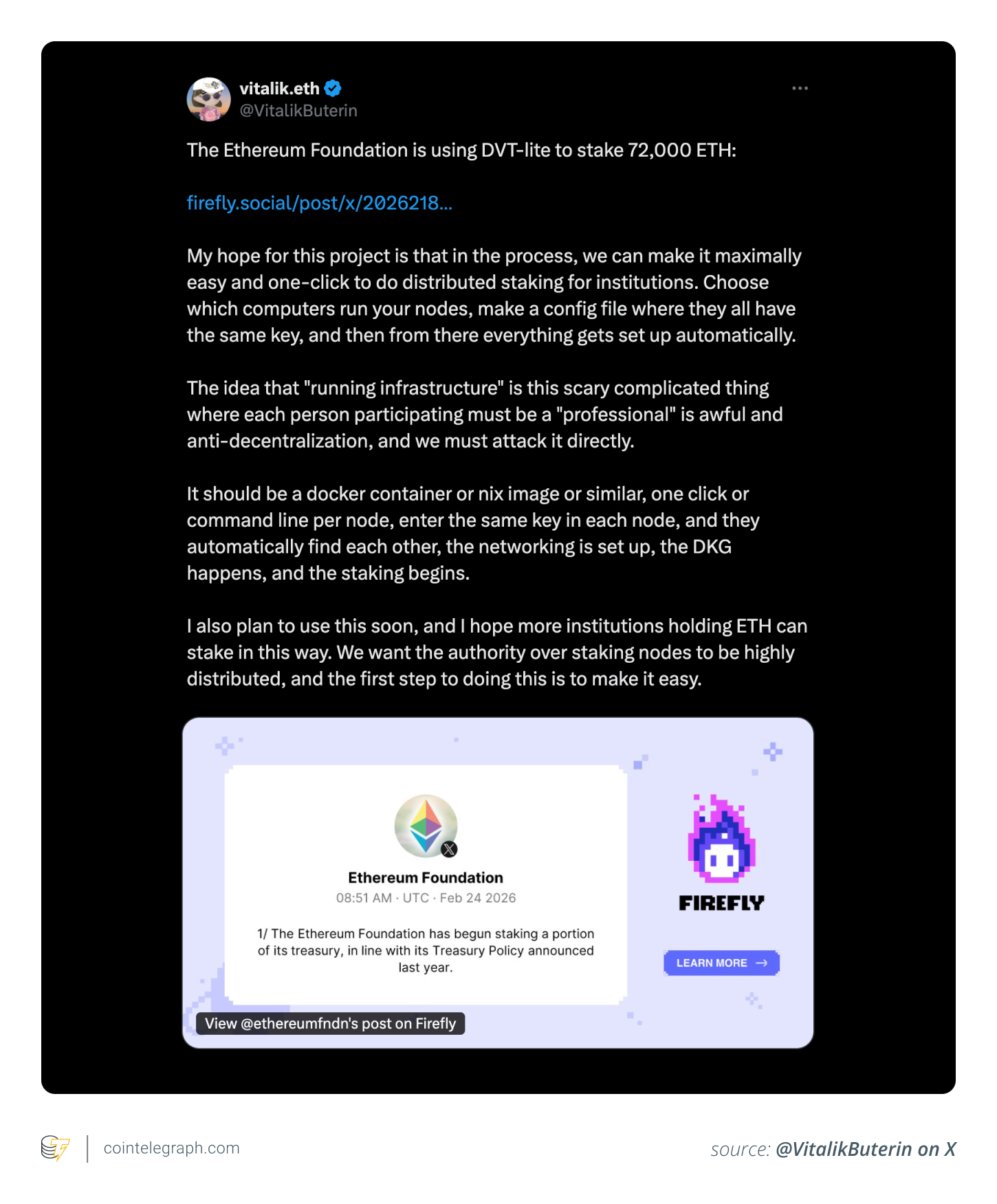
This pilot test will determine if streamlined distributed stakes can work reliably on an institutional level.
If the outcome is positive, it could serve as a template to crypto funds and corporations that want to bet their Ether without intermediaries.
This experiment shows that Ethereum’s developers see improved accessibility of validators as an important priority in the future development of the network.
What institutions can finally do to start stake
The economics of Ether institutional holdings could be fundamentally altered if one-click stakes materialize.
The Ether-rich entities could generate a staking return without involving third parties.
Some of the benefits include:
-
Infrastructure and operating overheads are significantly lower
-
Reduction of reliance on central staking providers
-
Transparency in operations
-
Distributed Validator Configurations: Enhanced resilience through stronger resilience
This could be a game changer for organisations that are managing Ether in the thousands.
Why developers believe simpler staking improves decentralization
Expanding validator participation is beneficial to the Ethereum network from a protocol perspective.
The validity of the validations is increased when there are more participants.
-
Nodes are distributed more geographically
-
Concentration of Validation Power Reduced
-
More resistance against censorship
-
Resistant to failures, disruptions and other problems
The Ethereum security model is strengthened by lowering the barriers to participation through more accessible staking.
Ethereum has always placed a high priority on participation and not relying on centralised infrastructure.
The timing of 2026 is important
Direct institutional stakes are now more possible due to several concurrent developments in the network.
The next Ethereum upgrade will focus on validator performance and scaling. As an example, proposals that are tied to the Pectra upgrade The maximum balance of validators would be increased from 32 Ether up to 2,048 Ether. The operators could now manage bigger stakes with a single validator, and the burden associated with running multiple separate validators would be reduced.
These changes, when combined with DVT deployments that are simplified, could reduce technical and management hurdles.
While the stake ecosystem is still growing, it continues to be a dynamic one:
-
The queues at the entry of validators can hold up to millions in Ether.
-
Exit queues remain relatively small
-
The annual stake rewards have now exceeded $2 billion
The indicators above reflect a sustained and long-term trust in Ethereum’s Staking Mechanism.
Did you Know? This is the idea behind “one-click deployment” Cloud computing platforms like Amazon Web Services and Kubernetes (where complex infrastructures can be launched without manual configuration) are the inspiration for in Crypto.
Ethereum: The challenges that remain
There are still obstacles, even with one-click stakes. The primary obstacles are:
-
User interface design: It is essential that institutions have interfaces to streamline their deployment, while still keeping in mind security issues.
-
Uncertainty in the regulatory environment: The cryptocurrency regulation in each jurisdiction is constantly evolving.
-
Operating oversight Security best practices and monitoring of automated systems must be adhered to.
To avoid automation creating unexpected vulnerabilities, developers must balance the ease of use against adequate safety measures.
Can simpler stakes introduce new risks to the system?
Overly simplistic tools may inadvertently lead to new centralization threats:
-
A widespread adoption of a single software stack across institutions can reduce the diversity of infrastructure.
-
Standardized systems can be high-value targets in attacks or exploits
-
Over-reliance on automation could lead users to overlook operational risk.
Ethereum developers need to prioritize accessibility and maintain a robust validator system.
Success would be a success
The one-click stake vision could result in several significant changes.
-
Ether institutions increasing direct stakes
-
Distribution of validators in diverse geographical and organizational areas
-
Dependence on centralised stake services reduced
-
Overall network resilience
This would make running the validator a more standard task than one that requires a high level of technical expertise.
Cointelegraph retains its full independence in terms of editorial content. Advertising, commercial partnerships, and partners have no impact on editorial decisions, including the commissioning of features and magazine content, and their publication.
“This article is not financial advice.”
“Always do your own research before making any type of investment.”
“ItsDailyCrypto is not responsible for any activities you perform outside ItsDailyCrypto.”
Source: cointelegraph.com


