

XRP adoption by banks has been the focus of crypto discussion for a long time, but the reality is much more complex than most in the community would like to admit. The regulatory uncertainty surrounding crypto and XRP in particular is a major obstacle for banks. Ripple’s CEO confirmed that despite Ripple’s victories in court against the SEC adoption of XRP by banks remains limited. As of this writing, the Ripple XRP gap remains between what has been settled by court rulings and what is actually needed by financial institutions.
You may also like: Something Unusual Is Happening With XRP Despite Price Crash
XRP Adoption by Banks: Uncertainty and Clarity in Crypto Regulatory Issues

What the data actually shows
Crypto content creator Crypto Sensei Recently, we revisited this issue by sharing a video based on comments made by Ripple’s CEO Brad Garlinghouse. It was an inconvenient argument: The XRP community claimed that regulatory clarity had already been reached, but this claim doesn’t hold water when you listen to what Garlinghouse has to say.
Crypto Sensei analyzed Ripple’s announcements from the last year-and-ahalf, looked into XRP metrics and reread the court rulings that should have settled the matter. The data did not reflect the surge that many anticipated. The data didn’t show the kind of surge many expected.
Garlinghouse Said What He Really Meant About Banks and XRP
Garlinghouse was very direct in his approach to this issue. On Fox Business, Garlinghouse explained the CLARITY Bill and what it would do for banks. He drew a distinct line between legal clarity XRP obtained from the SEC lawsuit and federal clarity which the industry as a whole still requires.
Garlinghouse was stated as:
“That’s clarity for XRP, but I think for the industry to really move forward in the United States, you need something like the Clarity Act to make it clear about other digital assets as not being securities.”
He also said that legislative progress will remove the largest blocker to banks. Garlinghouse stated that legal clarity will break the fear barrier that keeps large banks from investing in this sector, especially those in the US. In response to the question of what legislation will actually do, Garlinghouse was as direct:
“It unlocks banks in the United States and around the world to lean into this industry. If we get it codified into law, more financial institutions in the United States and globally will be leaning in.”
Right now, XRP banks adoption is at a very high level.
It is quite telling that the Ripple CEO made such a statement. Crypto regulatory uncertainty surrounding XRP goes beyond mere talk. Federal rules are needed, not simply legal precedents, for compliance teams at major financial organizations to sign off on the integration of a virtual asset into payment services. XRP adoption by banks at large requires this kind of clarity.
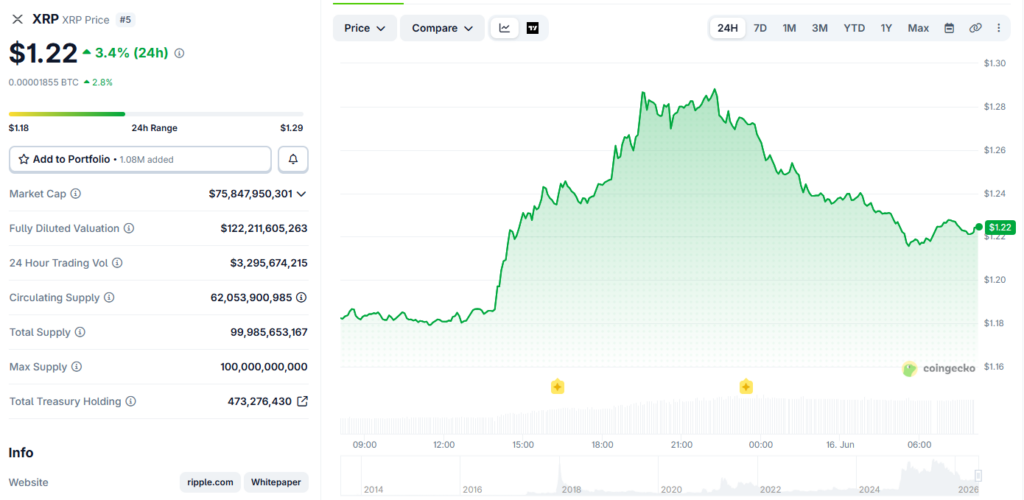
The time this was written is the current date. XRP trades at $1.22In the past 24 hours, grew by 3.4%, fluctuating between $1.18-$1.29. With a market capitalization of $75.84 billion and a 24-hour trading volume around $3.29 million, the circulating token supply is just over 62.5 billion.
Garlinghouse said that 2026 will be a record-breaking year in terms of corporate demand. Ripple Prime is the brokerage division. Business is clearly on the rise. But XRP institution adoption on a banking scale, where financial institutions use XRP regularly for cross border settlements is a totally different matter. Ripple XRP is not yet where it should be. XRP adoption by banks will depend on Washington’s actions, rather than on charts.
“This article is not financial advice.”
“Always do your own research before making any type of investment.”
“ItsDailyCrypto is not responsible for any activities you perform outside ItsDailyCrypto.”
Source: watcher.guru


