


Bitcoin (BTC), its most recent high, reached $81,325 in Tuesday’s trading. This is the highest it has been since January. Bitcoin has been at multi-month highs for several months. But are these just bear market rallies, or is it ready to start the “return of the bull”? “supercycle,” What do some traders say?
The key takeaways
- Bitcoin may rally to $180,000–$200,000 as institutional accumulation offsets bear-market pressure
- Selling pressure remains firm near the $80,000–$82,000 area.
BTC/USD price charts for the day. Source: TradingView
Bitcoin “supercycle” Next thesis aims at $250,000
Bitcoin is now up 35.70% from its February’s low of $59.30. BTC is still about 36% lower than its record high of $126,200 in October 2025. It has led to a debate between traders. Some analysts have predicted a return of new record highs in 2018.
Bitcoin has not entered a boom-bust pattern but is transitioning to its first “supercycle,” PlanC analyst says.
The, Tuesday post, he projected a move to above $250,000 by 2027–2028 from the $16,000 bear-market low in November 2022.
The current cycle is divided into three phases according to his framework: a rally up to 126,000 dollars (already accomplished), a correction mid-cycle toward $60,000, and finally a new expansion phase aiming for new highs over $250,000.
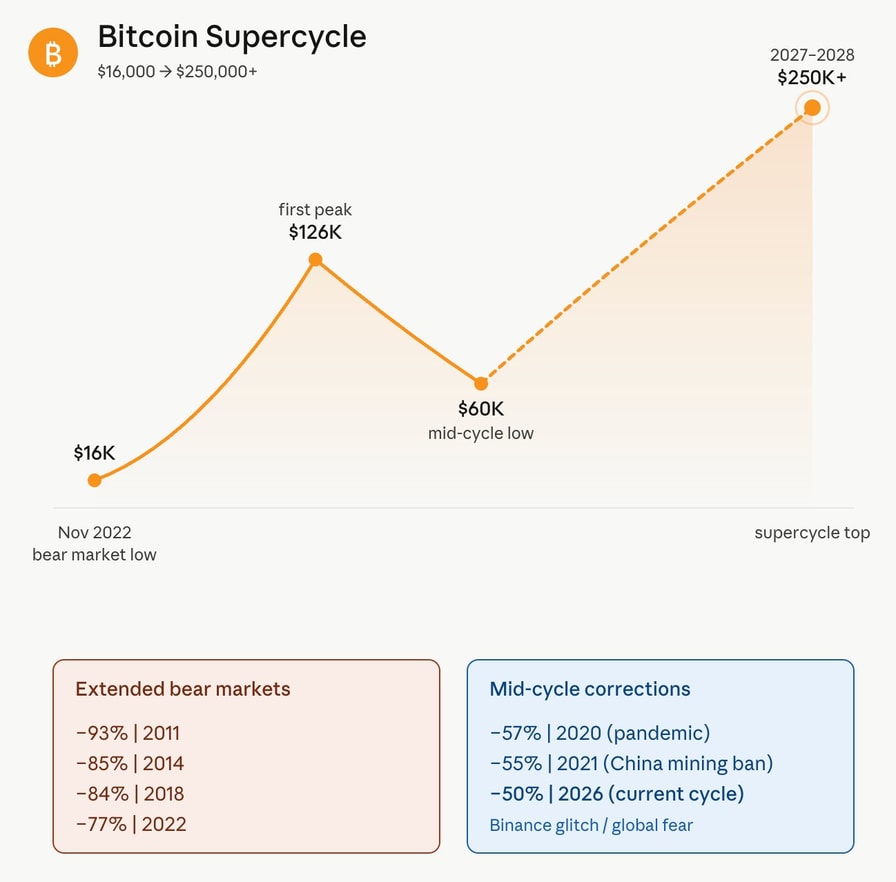
Bitcoin supercycle illustration. Source: PlanC
The key distinction, he noted, is that the recent ~50% drawdown resembles prior mid-cycle resets, such as 2020 and 2021, rather than the deeper 70%–90% bear markets seen in 2014, 2018, and 2022.
Institutional demand has increased in the present scenario. absorbing over 500% of the new daily BTC supplyThere are many ways to soften the impact of a crash.
The thesis still hinges on Bitcoin remaining above the mid-cycle level of around $60,000. The supercycle hypothesis would be nullified if Bitcoin fell below the mid-cycle floor of $60,000.
“I think once BTC clears the mid 80’s and holds the chances of seeing new highs are quite high,” analyst Pentoshi said The ongoing shortage of supplies was cited in an article published on Tuesday.
“He added”
“In terms of probabilities, I think the lows are in and we could see BTC trade as high as $180k between this year and next.”
Elliott Wave setup suggests that Bitcoin has reached its bottom.
Bitcoin’s recent rebound strengthens the argument that its correction since the January 2025 peak has ended, says trader Decode’s Elliott Wave analysis.
This chart indicates that BTC is likely to complete a three-part A, B and C correction with the final “C” The wave’s bottom is near $60.000 Elliott Waves usually mark the end of this phase, which can be followed by a 5-wave uptrend.
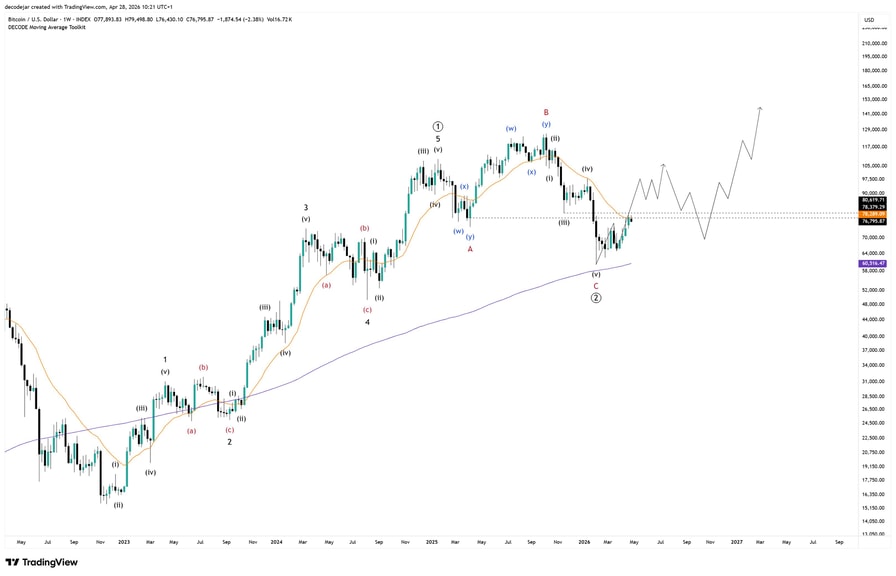
BTC/USD chart for the week. Source: TradingView/Decode
Decode notes Bitcoin has moved above its low of November, if even slightly. The overlap invalidates wave counts for the “bearish” direction.one more lowThe same downward impulse.
In turn, this has weakened the case for bears. BTC might still be within a large correction, but a cleaner setup indicates that recent $60,000 was most likely a new cycle low.
A decisive reclaim of the $78,000–$80,000 range as support would further boost the odds of a BTC price rally toward $90,000–$100,000 next.
Sellers move in close to a critical resistance convergence
Bitcoin’s recent rebound has run into an old resistance group, which raises the possibility of a temporary pullback.
As of Tuesday, BTC is testing the confluence of its 200-day exponential moving average (200-day EMA, the blue line) and the upper boundary of a bear flag channel near the $80,000–$82,000 region.
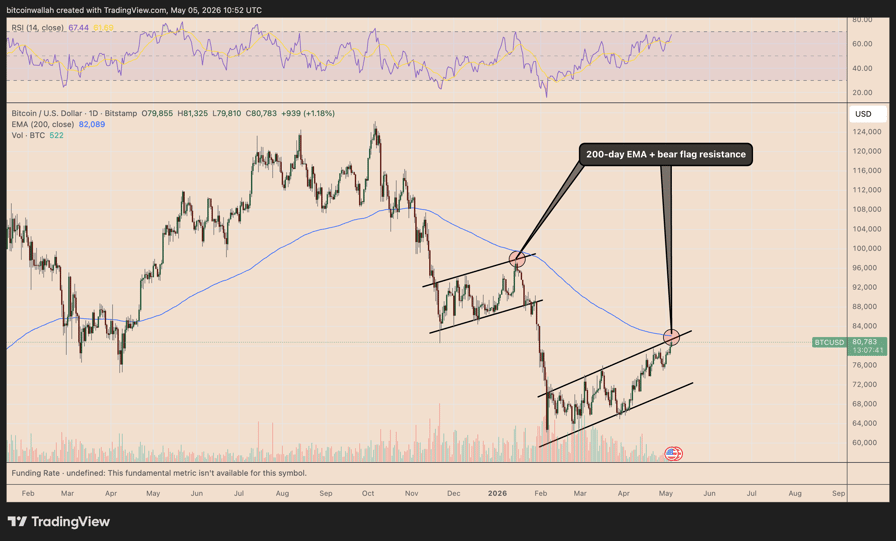
BTC/USD chart. TradingView
This resistance confluence increases the odds of a Bitcoin pullback in the coming days, with the downside target sitting around the flag’s lower trendline near the $70,000–$72,000 area.
Price could fall below $50,000 if the trendline is broken.
In January of this year, Bitcoin rose to its 200-day EMA following a long downtrend. However, it failed to move higher. This rejection caused a second leg of decline before an even more stable bottom was formed.
As shown in the chart, in previous years, Bitcoin bear markets rallies were resisted by the 200-day EMA. This was particularly true in 2018 and in 2022. shared Jason Pizzino, analyst

Source: X
During the bear market of 2018, BTC dropped an average 40% when it tested the 200-day EMA. The average decline in 2022 was 35.5%.
Related: Bitcoin short-term cost basis approaches profitability, but $80K must flip to support first
BTC price may decline to the $48,000–$52,000 range if the fractal repeats, aligning with the bear flag downside target.
“This article is not financial advice.”
“Always do your own research before making any type of investment.”
“ItsDailyCrypto is not responsible for any activities you perform outside ItsDailyCrypto.”
Source: cointelegraph.com


