


Ether is the balance.ETHETH (ethereum) on exchanges fell to a new low. More than 31 millions ETH were removed from centralized exchanges during February. This was the largest withdrawal of ETH since November.
Although the ETH prices remained close to $2,000, data from derivatives shows a division between large buyers and small sellers. It raises questions about how price might respond if retail wallets as well as whale wallets demand become uniform.
Reserves of ether signal a supply crunch
Crypto Analyst Arab Chain said In February more than 31 million ETH have left major exchanges, which is the largest monthly withdrawal since November. Binance led the way with approximately 14.45 millions ETH withdrawn – nearly half. OKX was next with approximately 3.83 millions ETH and Kraken had close to 1.00 million ETH.
Withdrawals that are sustained reduce the amount of coins easily available for trading. In the short-term, coins that are moved to private wallets and staking platforms tend to be less liquid. Due to this, a thinner balance can increase the volatility of prices when there is a spike in market activity.
CryptoQuant data Binance’s Ether Reserves have also fallen to 3.46 Million ETH. This is the lowest since 2020. The previous cycle saw reserves peaking at over five million ETH, before a downward trend marked by lower highs began. This latest reading continues that trend.
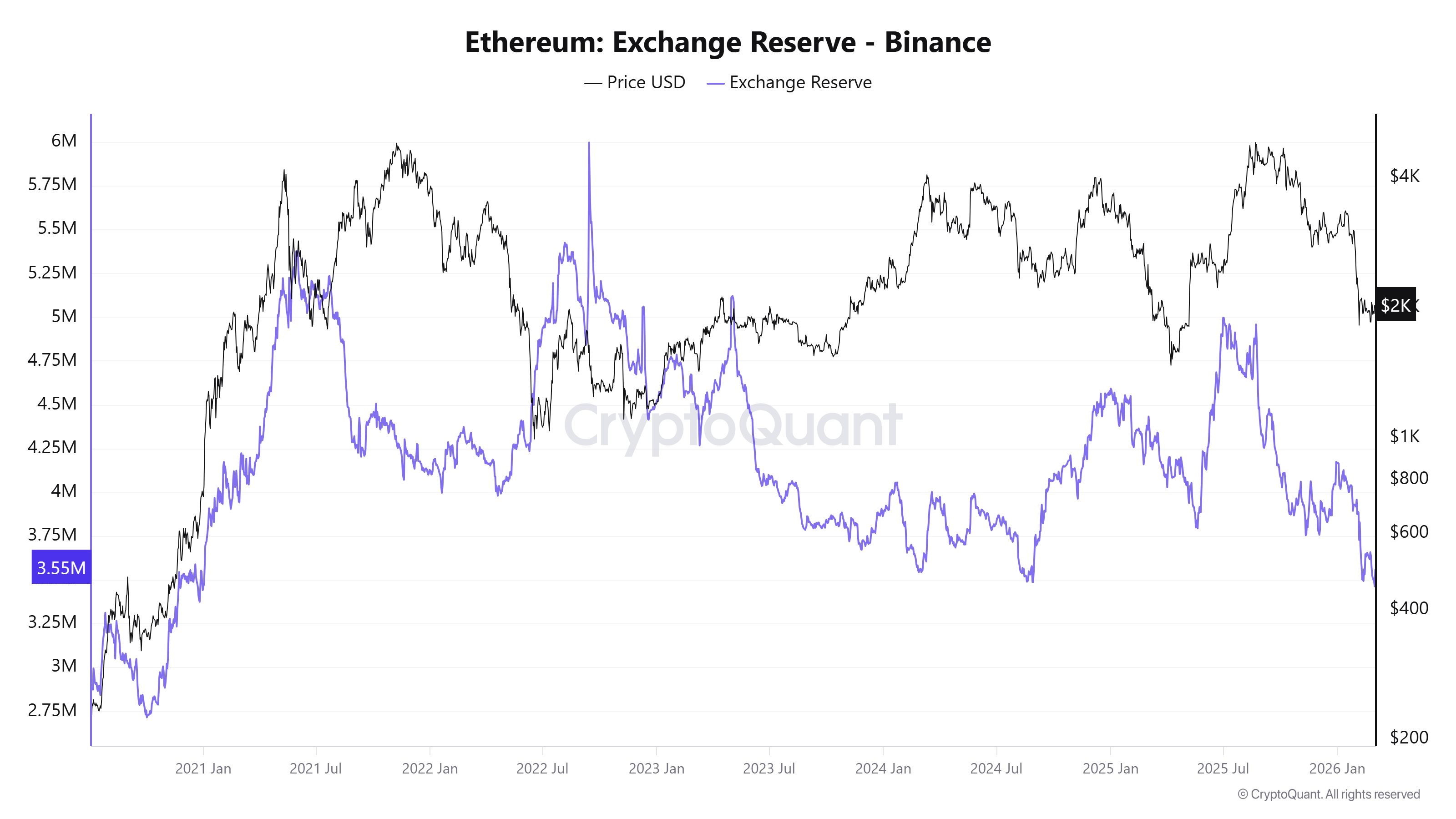
As ETH trades below $2,000 the tightening of exchange supplies puts a greater focus on demand. Order books will become more liquid if buying pressure continues to increase while reserves are falling.
Related: Ether price again rejected at $2K: How low can ETH go in March?
The retail market remains divided between whales and retailers
Data from Hyblock revealed a wide range of trade sizes. In smaller trades (between $0 and $10,000), the CVD, which measures net aggressive buying or selling, hovers around $95 Million. The retail pressure is consistent.
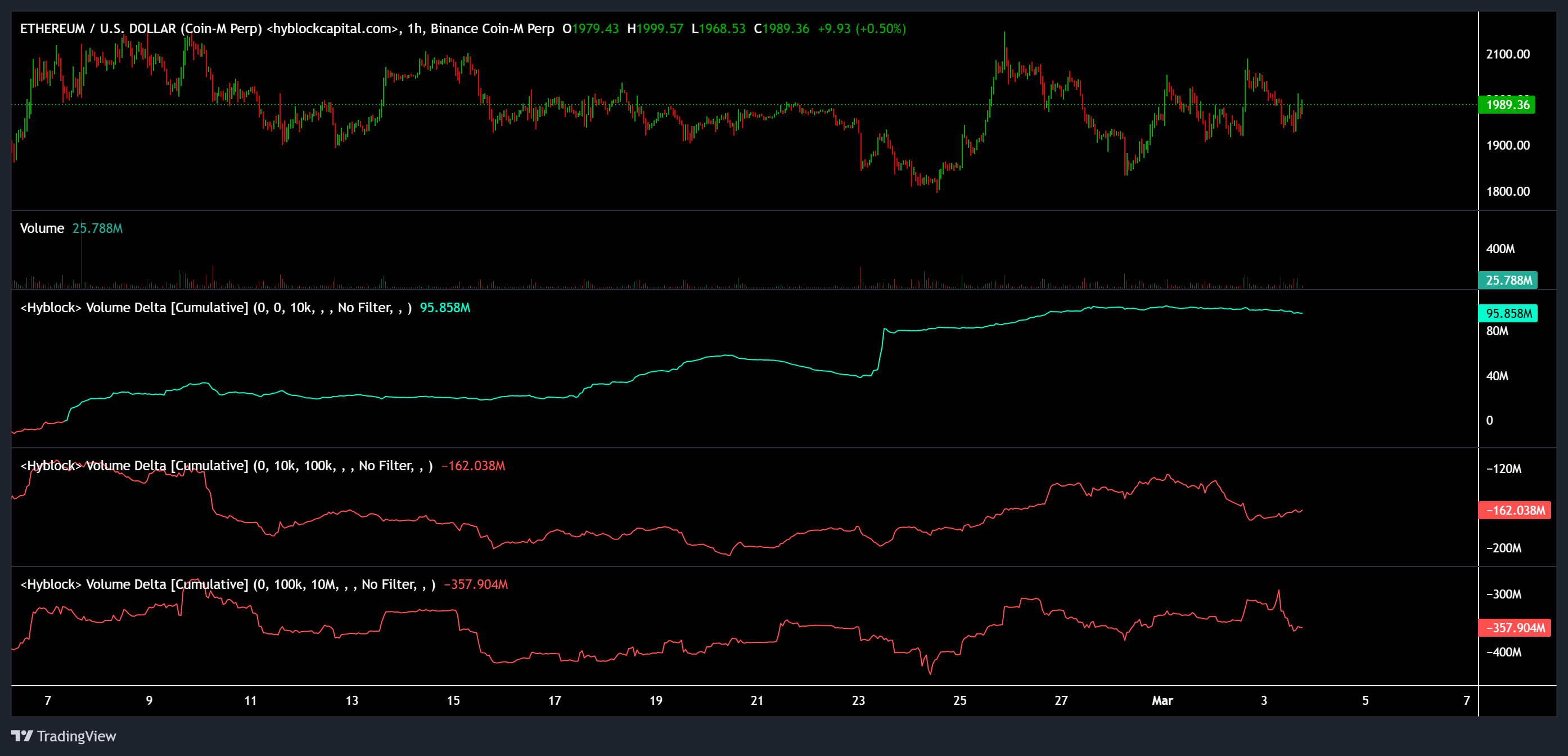
In contrast, the $10,000–$100,000 trade bracket records about -$162 million in CVD, while the $100,000-plus category sits near -$357 million. As can be seen, larger players have been more inclined to net sales during this period.
The bid–ask ratio has turned slightly positive, rising to about 0.2 before dipping to 0.03, indicating marginally stronger buying interest in recent sessions. This move comes after a string of negative readings, and indicates a short-term stability rather than broader conviction.

Open interest has dropped from close to $10billion in February. As the price of the security consolidates between $1,900 and $2,000, this reduction shows that leverage has decreased.
In the event that retail accumulation is sustained and sales on a large scale slow down, bullish position may be more aligned. The reduced supply of exchange may amplify price movement once ETH reaches a level above $2,000 or $2150.
Related: AI ‘vibe coding’ could put Ethereum roadmap ahead of schedule: Vitalik Buterin
The article is not intended to provide investment advice. Each investment or trading decision involves risk. Readers should do their own research before making any decisions. Cointelegraph, while striving to give accurate information and in a timely manner, does not guarantee accuracy, completeness or reliability. This article might contain risky and uncertain forward-looking statements. Cointelegraph is not responsible for loss or damages resulting from your reliance upon this information.
“This article is not financial advice.”
“Always do your own research before making any type of investment.”
“ItsDailyCrypto is not responsible for any activities you perform outside ItsDailyCrypto.”
Source: cointelegraph.com


