

Bitcoin’s future price is closely tied to global liquidity. Capital is more readily available as liquidity rises, which in turn increases the amount of capital flowing into high-risk assets like Bitcoin. But in the evolving landscape of this market, there is a more sensitive and accurate metric, which correlates strongly with BTC prices, but also has a specific ecosystem.
Global M2
Start with the Global M2 vs BTC chart. It is no surprise that this chart has been the one most shared on Bitcoin Magazine Pro and the most analyzed during the current bull run. The M2 Supply includes all the physical currencies and other near-money in an economy. It is a good indicator of the central banks’ and fiscal policies when aggregated across all major economies.

Histoically, Bitcoin has risen explosively when there have been major M2 expansions, especially if they are driven by money-printing and fiscal interventions. This was evident in the bull run of 2020. Bitcoin soared to more than $60,000 from a low of a few thousand dollars. In 2016-2017 a similar pattern was observed, while in periods such as 2018-2019 or 2022, M2 contraction coincided with BTC decline markets.
A Stronger Correlation
The raw M2 chart may be compelling but viewing it in context is more valuable. Global M2 vs BTC Year-on-Year It provides an actionable perspective. The base M2 is almost always on the rise because governments tend to print more money. The rate at which the acceleration or deceleration occurs tells us a completely different story. Bitcoin usually rallies when the growth rate year-over-year of M2 increases. Bitcoin usually struggles when the growth rate of M2 is negative or falling. Despite the short-term noises, this trend highlights the strong connection between Bitcoin’s bullishness and fiat liquidity growth.

There’s one caveat, though: the M2 data are slow. This takes time for data to be collected, updated, and reflected across the economies. The impact of greater liquidity is not felt immediately by Bitcoin. New liquidity initially flows to safer assets, like gold or bonds. Then, the new liquidation moves into equities and then, only later, into speculative, higher volatility assets, like BTC. Timing strategies are dependent on this lag. This data can be delayed, but it still remains the same.
Stablecoins
Stablecoin liquidity is a better and more crypto-native way to address the latency. BTC and the major stablecoins’ supply (USDT USDC DAI etc.) can be compared. This shows a stronger correlation with M2 than ever before.

Now that we have a better understanding of what stablecoins are worth, tracking their raw supply is valuable. But to really gain an edge over the competition, you need to examine how much they change in a month. This supply change is a strong indicator of trends in short-term liquidities. It is common for the BTC rate to turn positive at the beginning of a new accumulation phase. It is a good indicator of local tops or retracements when it becomes sharply negative.

BTC surged to new heights at the end of 2024 as stablecoin supply grew rapidly. Similar to the 30% major drop earlier this year, a sharp decline in stablecoin demand was preceding it. This metric tracked these moves to the minute. The recent rise in BTC is being reflected in the more recent increases in stablecoins. priceThe crypto market is experiencing a new influx of money.
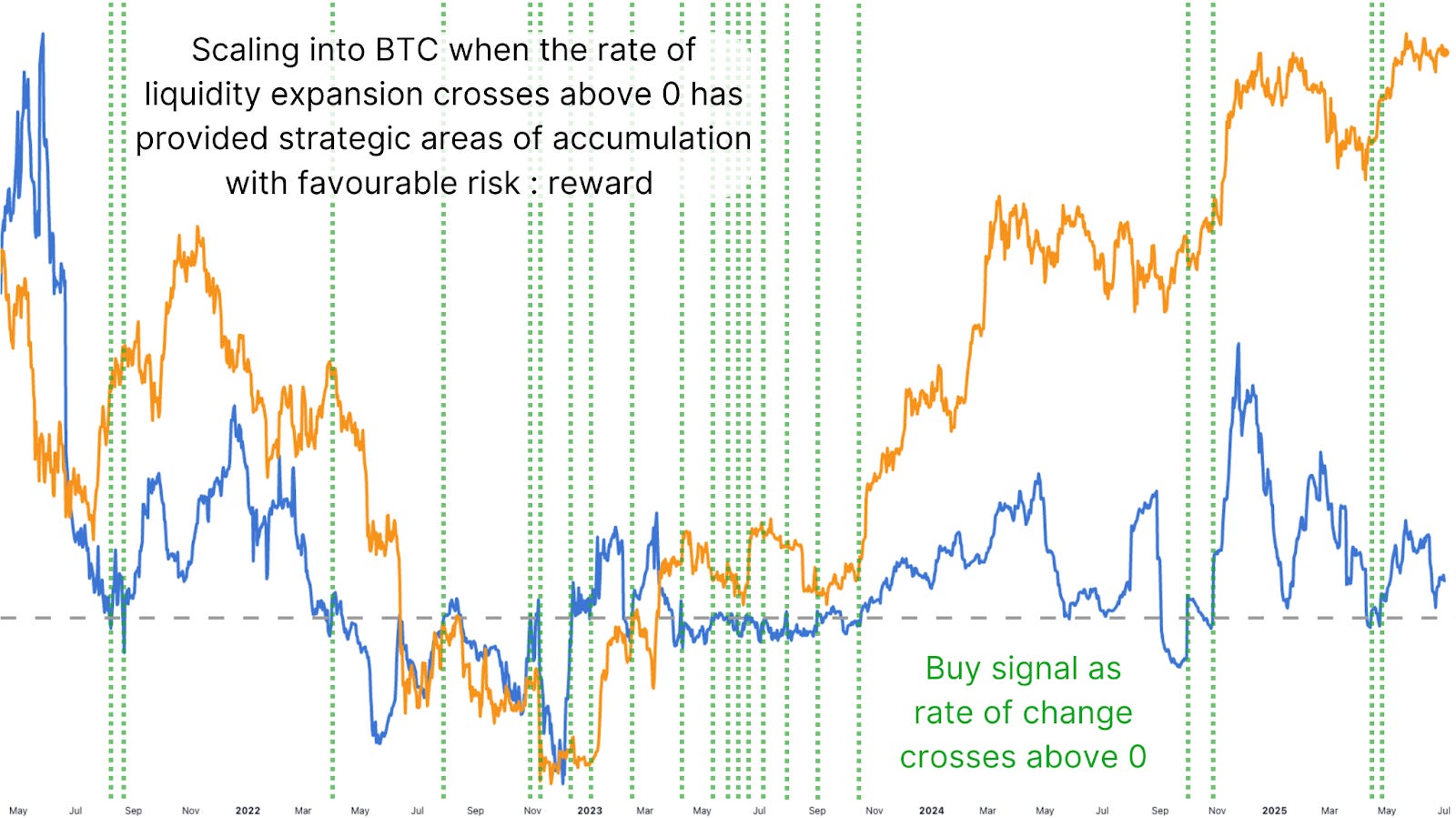
Figure 5 In the past the indicator set off by the crossing of the liquid rate above zero was an accurate buy signal.
This data’s value is not new. Tether Printer Twitter accounts have been around since 2017, when crypto veterans would watch every USDT coin as a sign for bitcoin pumps. Now we are able to measure it more accurately, live, with rate-of change analysis. This is made even more powerful by the ability to track intraday and intracycle. The Global M2 chart updates rarely, but stablecoins liquidity data is available in real-time and can be used to track positive changes in the change.
You can also read our conclusion.
Stablecoin Rate-of-Change Metric provides Clarity for Intra-Cycle Positioning. Global M2 Growth aligns to long-term Bitcoin Trends. Every analyst should have this in their toolkit. It has been remarkably successful to use a simple approach, like looking for crossovers over zero for the 28-day change rate for accumulation and consider scaling out when there are extreme spikes.
💡 This deep dive into Bitcoin price dynamics is fascinating! Subscribe to Bitcoin Magazine Pro on YouTube More expert insights and market analyses!
Visit for more in-depth research, market analysis and alerts as well as technical indicators. BitcoinMagazinePro.com.

Disclaimer: This article does not constitute financial advice. It is only for informational and educational purposes. Do your research prior to making investment decisions.
“This article is not financial advice.”
“Always do your own research before making any type of investment.”
“ItsDailyCrypto is not responsible for any activities you perform outside ItsDailyCrypto.”
Source: bitcoinmagazine.com


