


You can also find out more about the following: real-world asset (RWA) Tokenization has emerged as one of digital asset’s most important areas. In the last two years the discussion around the blockchain has moved away from speculation to practical financial infrastructure.
The 2026 financial year will see a rise in interest for cryptocurrencies linked to tokenized asset, settlement systems and the blockchain.
RWA is a relatively new concept. These blockchain networks connect decentralized infrastructure to traditional financial assets, such as commodities, bonds, payments and invoices. This project aims to link digital networks to real economic activity, rather than focusing on cryptos.
Why are real-world assets tokens gaining traction in 2026
RWA tokens receive more attention by 2026 due to the adoption of rails which bring traditional finance into blockchain. This emerging narrative is a big draw for coins, and those that are exposed to it have benefitted from this hype. As market participants increasingly look to the early tokenization stages to make investments.
RWAs have continued to grow in the RWA industry. Total tokenized assets are now worth over $33.8billion, as the real world assets seem to have moved into blockchains.
This traction can be attributed to the fact that traditional financial institutions are becoming more familiar with blockchain infrastructure. The major asset managers, banks, and payment firms are testing out tokenized products, blockchain-based liquid systems, and stablecoin settlements.
Regulation is another major factor. In the last 12 months, a number of jurisdictions have clarified their frameworks on tokenized security and blockchain settlement. The US SEC is expected to issue a guideline on innovation exemptions that will allow securities tokenization via blockchains. This will be a major breakthrough. This clarity encourages more traditional companies to try out blockchain technology without being held back by the uncertainties that had previously hindered adoption.
Tokens are now reflecting the increasing interest in RWA. We have highlighted 10 of the most popular RWAs as investor interest continues to grow. tokens by market cap In today’s world, the market is very different.
Top 10 RWA crypto tokens by market cap in 2026
| The Rank | Token | Prices are as follows: | Market Cap | Focus |
|---|---|---|---|---|
| 1 | Chainlink (LINK). | $9.80 | Seventeen billion dollars | Oracle Infrastructure and Tokenized Asset Connectivity |
| 2 | Stellar (XLM) | $0.1480 | 4.96 billion dollars | Financial settlements and cross-border payments |
| 3 | Avalanche (AVAX) | $9.53 | 4.17 billion dollars | Blockchain infrastructure for institutional use |
| 4 | Hedera (HBAR) | $0.090 | $3.9 billion | Enterprise-grade distributed ledger systems |
| 5 | Ondo (ONDO) | $0.409 | 1.95 billion dollars | Tokenized Treasury and financial products |
| 6 | Sky (SKY) | $0.0707 | $1.643 billion | Decentralized financial infrastructure |
| 7 | Algorand | $0.115 | One billion dollars | Tokenization systems and payment rails |
| 8 | Quant (QNT) | $73.8 | 891 Million Dollars | Blockchain interoperability |
| 9 | XDC Network | $0.0345 | Seventy-nine million dollars | Trade Finance and Enterprise Settlement |
| 10 | VeChain | $0.0067 | Five hundred and seventy-nine million dollars | Supply Chain and Logistics Tracking |
Chainlink (LINK).
Chainlink has the highest market cap of any RWA focused crypto. This network has a significant role to play in integrating blockchains with off-chain information.
Oracle’s infrastructure is widely used for tokenized financial applications. The cross-chain protocol (CCIP), which is used by Coinbase, SWIFT and SBI Digital, has been widely adopted.
LINK’s market capitalization is $7.15 billion. It trades for $9.80. Analysts predict that LINK will end the year strong, despite being down by 19% so far this year. Assets could reach $15 in 2026.
Stellar (XLM)
Stellar Positions itself as a Blockchain focused on low-cost settlement and payments. But its scalability, high-speed security and institutional-grade have made it popular in the tokenization market.
Stellar now has RWA tokens worth over $2.4billion distributed on the network. That’s an 11% increase in just 30 days. The 30-day volume is $275.5 millions. the US Treasuries The most tokenized asset classes on the platform.
XLM is its native token and it trades for $0.148. This price has dropped 26% from January 1st. The market capitalization of the coin, XLM stands at $4.96 Billion. The coin’s price could realistically reach $0.220 by the end of the year 2026. This would be a 50% increase from its current value.
Avalanche (AVAX)
Avalanche The customizable architecture of the subnets has increased institutional interest. Avalanche is a popular choice for financial companies experimenting in tokenized products due to Avalanche’s high scalability.
Avalanche has over $1.8B in RWAs live, making it the ninth-largest network. Avalanche distributes $1.2 billion in RWAs, and $678 millions is represented.
AVAX is currently trading at $9.53, with a $4.17billion market capitalization. The token, if we assume a conservative outlook, could hit $12 by the end of this year.
Hedera (HBAR)
Hedera’s corporate governance and enterprise partnership structure has helped it carve out a unique niche. The network’s focus has always been on business adoption, compliance friendly infrastructure and enterprise grade settlement systems.
In February, Hedera ranked RWA is ranked first in RWA’s blockchain activity. This indicates its important role in the facilitation of physical asset integration into blockchain infrastructure. The low-cost and high-speed set-up is designed for institutions that want to tokenize physical assets.
HBAR is currently trading at $0.09 with a $3.9 billion market capitalization. If momentum increases, the token may reach $0.204 by the end of the year 2026.
Ondo Finance (ONDO)
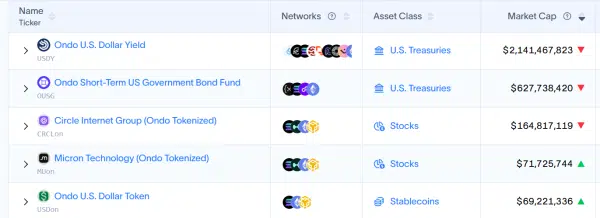
Ondo is one of the most rapidly-growing RWA projects, thanks to its focus in tokenized Treasury Products and Blockchain-based Financial Instruments. Platform visibility has increased as tokenized yield products have continued to attract institutional interest.
Ondo’s tokenized assets totaled over 3,85 billion dollars, of which the vast majority were US Treasuries. Its two biggest products are US dollar yields as well as short-term US government bond.
ONDO is now trading at $0.409 – up by 14% year to date. On a conservative basis, the coin’s adoption could see it trade for $0.63 at the end of the year.
Sky (SKY)
Sky’s decentralized infrastructure is tied to digital settlement and tokenized system layers. The ecosystem is among the biggest decentralized financial systems, incorporating traditional finance in order to produce yields for its holders.
SKY has risen 22% in value since the beginning the year. According to projections, the token will be nearing $0.09 in 2026.
Algorand
Algorand is still active with tokenization and the blockchain payments infrastructure. The project maintains a reputation of high transactional efficiency and low cost network.
Currently, over $99 million Algorand’s Algorand Standard Asset (ASA) framework makes onboarding easy, allowing users to tokenize directly at the network layer. Algorand Standard Assets (ASA), its framework, makes tokenization easy. Users can do it directly at the network layer.
ALGO is its native token and trades for $0.115. The market capitalization of the coin is $1 billion. According to projections, the price of the coin could increase slightly by 2026.
Quant (QNT)
Quant is primarily focused on interoperability, i.e. the ability of blockchains to work with existing financial infrastructure. Interoperability has become increasingly important as institutions use more blockchain networks at the same time.
Platform uses Overledger OS for interoperability, connecting RWA protocol securely. Quant is a leading partner for the European Central Bank’s digital Euro project.
QNT is trading at $73.8 this year, an increase of 6%. The coin may reach $115 if the adoption rate increases.
XDC Network
The XDC Network targets trade finance markets and enterprise settlements using the Delegated Proof of Stake (XDPoS). Project XDC has focused on document validation, cross-border payment of business and tokenized workflows.
RWAs of over $17 millions have been distributed through the XDC Network, and its market capitalization in stablecoins exceeds $72.7 million.
XDC was trading for $0.0348 at the time of publication, and its market cap is $710,000,000. It is possible that the coin will reach $0.0735 before 2026.
VeChain
VeChain is a blockchain-as-a-service (BaaS) network, heavily focused on supply chain verification and logistics tracking. It does not tokenize assets directly, but it is specialized in tracking and verifying RWAs by using Internet of Things.
VET is currently trading at $0.0067, with a value of $579,000,000. By the end 2026, the projections place the coin in a target range of $0.0072.
How Do RWA Tokens Work?
RWA tokens represent real-world economic or financial value in blockchain networks. Some of these tokens are tied to ownership rights for physical assets, such as commodities, real estate or invoices. They can also be used as a payment system, a settlement layer, or underlying financial data infrastructure.
RWA networks are often used as the foundation of tokenized financial products. In order to make value transfers more transparent and efficient, financial institutions do not have to rely on the traditional rails of banking. Instead they can utilise blockchain-based systems.
Some projects focus also on tokenized products for treasury, while others are specialists in data infrastructures, interoperability and institutional settlement systems. RWA Tokens, despite their differences share a common goal: to connect blockchain technology and traditional financial activities.
RWA Crypto Coins – Benefits
Many market participants pay more attention to RWA coins because the sector offers practical financial applications. Many projects have already partnered with companies such as payment providers, asset managers or enterprise software. Market participants estimate that this sector is worth more than $100 billion by 2025. trillions of dollars in the future.
Diversification in the crypto industry is another advantage. RWAs may be able to benefit from growing institutional markets and adoption of tokenized projects.
This sector may also be able to benefit from a shift in the financial industry towards a digital infrastructure. The blockchain networks which can be used to support such systems will likely gain more relevance in the future as tokenized assets are becoming increasingly common.
RWA Tokens: Risks you should consider before investing
The RWA industry still faces significant challenges, despite the optimistic outlook surrounding tokenized assets. Regulators remain one of the greatest uncertainties. Although certain regions have adopted clearer regulations, global standards of regulation remain inconsistent.
The issue of scalability is also an important one. It is still early days for many tokenization efforts, and we don’t know how fast traditional financial systems are going to integrate blockchain technology.
Also, the competition remains fierce. Multiple blockchain networks try to establish themselves as preferred infrastructures for tokenized payments, institutional settlement, and tokenized finance. As a result, not all projects will be successful over the long-term.
Sector volatility, security threats, vulnerabilities in smart contracts, and the crypto-market as a whole continue to affect it. During periods of macroeconomic instability, even projects that are fundamentally sound can see significant drops.
RWA Coins: How to Purchase?
Major centralized exchanges offer the majority of RWA currencies. Users create an account after completing the identity verification process and fund it using fiat currency.
After buying tokens, users can choose to keep them on an exchange, or transfer them to a self-custody wallet for added security. Hardware wallets are still the preferred storage solution for long-term investors.
It is essential to do research on the RWA project before purchasing any crypto assets. This includes researching its utility, institution partnerships, tokenomics and long-term road map. The sector may be gaining attention by 2026 but individual projects could still have very different performances depending on market conditions and adoption rates.
Find out more about Crypto news today Latest news and updates crypto price prediction updates, visit our dedicated coverage hub
DisClamier: The content of this article is for informational purposes only and does not constitute financial advice. The opinions expressed by the author in this article are their own and not The Crypto Basic’s. The readers are encouraged to conduct thorough research prior to making investment decisions. Crypto Basic will not be held responsible for any losses.
“This article is not financial advice.”
“Always do your own research before making any type of investment.”
“ItsDailyCrypto is not responsible for any activities you perform outside ItsDailyCrypto.”
Source: thecryptobasic.com


