

Satoshi’s wallet: a prime target for quantum attacks
Satoshi’s 1.1-million BTC wallet has become a quantum vulnerability, with researchers assessing how computing power can affect the early Bitcoin address.
Satoshi’s Nakamoto estimated bitcoin number of 1.1 Million (BTCIt is sometimes described as “the ultimate crypto currency” “lost treasure.” The digital ghostship has sat on the blockchain for years without a single onchain transaction. It has now become legend that this massive collection, valued at between $67 and $124 billion, is still there.
For cryptographers as well as for scientists, the threat is a security concern worth billions of dollars. This threat does not come from a hacker breaching a server or losing a password. It comes from the advent of a completely new way of computing: quantum computing.
Quantum machines, as they move from the theoretical lab to powerful prototypes in production, pose a threat to cryptographic systems. It includes encryption which protects Satoshi’s coin, the Bitcoin network as a whole and some parts of the financial infrastructure.
This is a real distance. “what if.” The race between building a quantum computing device and one that can also perform calculations on a quantum-resistant defense This is one of most important and funded technological initiatives of our times. What you should know
Satoshi’s wallets from the early days are easy targets for quantum attacks
The public key is usually hidden until the transaction has been completed. Satoshi’s old pay-topublic-key addresses (P2PK) do not and the public key is permanently displayed onchain.
It is crucial to understand that all Bitcoin addresses do not equal the same thing. Satoshi’s addresses from 2009 and 2010 are the source of vulnerability.
Most Bitcoin today is held in pay-to-public-key-hash (P2PKH) addresses, which start with “1,” SegWit addresses that start with “bc1.” These address types do not allow the full public-key to be stored on the blockchain when coins are being received. Instead, only the hash is saved, with the real public-key only revealed when the coins have been spent.
Imagine it as a drop-box at a bank. Anyone can drop cash in the slot. Behind the mail slot is a locked metal door. This is where the public key can be found. Lock and mechanism are hidden from view. Public key “lock”The private key will only be revealed when you choose to spend the coins. “unlocks” it.
Satoshi coins are however stored on much older P2PK accounts. This legacy format does not have a hash. In our analogy, we can see that the public key, or the lock, is permanently and visibly recorded on the Blockchain.
This does not affect a classic computer. Although it’s still impossible to reverse-engineer the public key in order to obtain its private key, there are ways to do so. A quantum computer can use the public key as a detailed plan. The lock is open to anyone who wants it.
Shor’s algorithm allows quantum machines to break Bitcoin
Elliptic Curve Digital Signature Algorithm is the basis for Bitcoin’s Elliptic Curve Digital Signature Algorithm. It relies on math which classical computers cannot reverse. Shor’s algorithms, when run by a powerful enough quantum computer, are designed to reverse that math.
Bitcoin’s security model ECDSA forms the basis of this system. This is due to a mathematical one-way assumption. The process of multiplying a private-key by the point on the curve is simple, but it’s essentially impossible for the public key to be reversed to get the private key. The Elliptic Curve Discrete Logarithm Problem is the name of this problem.
The classical computer is not able to perform any of these functions. “divide” It is a brute force approach. This operation’s only choice is brute-force, which involves guessing each possible key. There are 2256 possible keys, which is a huge number that exceeds even the atoms of the universe. Bitcoin can be protected from any classical supercomputer on Earth today and into the future.
It would calculate. The quantum computer would be able to calculate.
Shor’s Algorithm, developed in 1994, is the tool to do this. If the underlying structure is sufficiently robust, it can be used to determine whether or not there are any problems. powerful quantum computerThe algorithm is able to use quantum superpositions in order find hidden patterns of mathematics, namely, the period. The algorithm can reverse engineer a public key in hours or even days to determine the private key behind it.
A hacker would not have to compromise a server. It would be easy to harvest P2PK’s public keys, put them in a Quantum Machine, then await the return of the private key. They could then sign the transaction to move Satoshi’s 1.1 millions coins.
Did You Know? To break the encryption of Bitcoin, it is believed that a machine would need to have about 2,330 stable logical qubits. Due to the noise and errors that are present in current qubits, it is believed by experts that a fault-tolerant device would require more than one million qubits.
What is the closest we are to Q Day?
Companies like Rigetti, Quantinuum and others are in a race to develop a quantum computer that is cryptographically useful. The timeline has shrunk from decades to just 1-2 years.
“Q-Day” This is the hypothetical time when a quantum computing system can break current encryption. Years ago, this was considered an improbable scenario. “10-20-year” Problem, the timeline has now become increasingly compressed.
Quantum error-correction is why 1,000,000 physical qubits are needed to produce 2,330 logical qubits. The qubit is incredibly delicate. The qubits can decohere or lose their quantum states if they are exposed to slight temperature variations, vibrations, or radiation.
For a calculation that is as complicated as breaking ECDSA you will need stable logical quabits. For a single qubit of logical information, it may be necessary to combine hundreds or thousands of physical qubits. The system overhead is required to maintain stability.
In a race that is rapidly intensifying, we are now in the quantum era.
-
Quantinuum and Rigetti, as well as tech giants like Google and IBM are pursuing aggressive quantum roadmaps.
-
Rigetti is on course to achieve a system with 1,000 or more qubits by 2027.
-
The progress that is visible to the public does not reflect classified research conducted at state-level. First nation to achieve Q-Day would theoretically have the key to all global intelligence and financial data.
Defence must therefore be constructed and deployed prior to the possible attack.
Quantum attacks on Bitcoins: Millions of Bitcoins are at risk
The 2025 Human Rights Foundation found that 6,51 million BTC was in the hands of vulnerable individuals, while 1,72 million, including Satoshi’s, were considered to be lost or unmovable.
Satoshi’s wallet may be the most valuable prize but isn’t the only one. A date in October 2025 report Human Rights Foundation examined the whole blockchain for any quantum vulnerability.
These findings are shocking
-
Long-range quantum attacks are possible against 6.51 BTC.
-
The estimated Satoshi BTC of 1.1m BTC is among the 1.72m BTC that may be in dormancy or lost.
-
Migration could secure an additional 4,49,000,000 BTC, indicating that the owners of these BTCs are still likely to be able act.
Users made the critical error of reusing addresses. This 4,49,000,000 BTC is theirs. After spending money from the modern P2PKH address (which revealed the public key), users received funds to this same address. In the early 2010, this was a common practice. They exposed the public key permanently by reusing their address. This made their wallets modern as well as Satoshi’s.
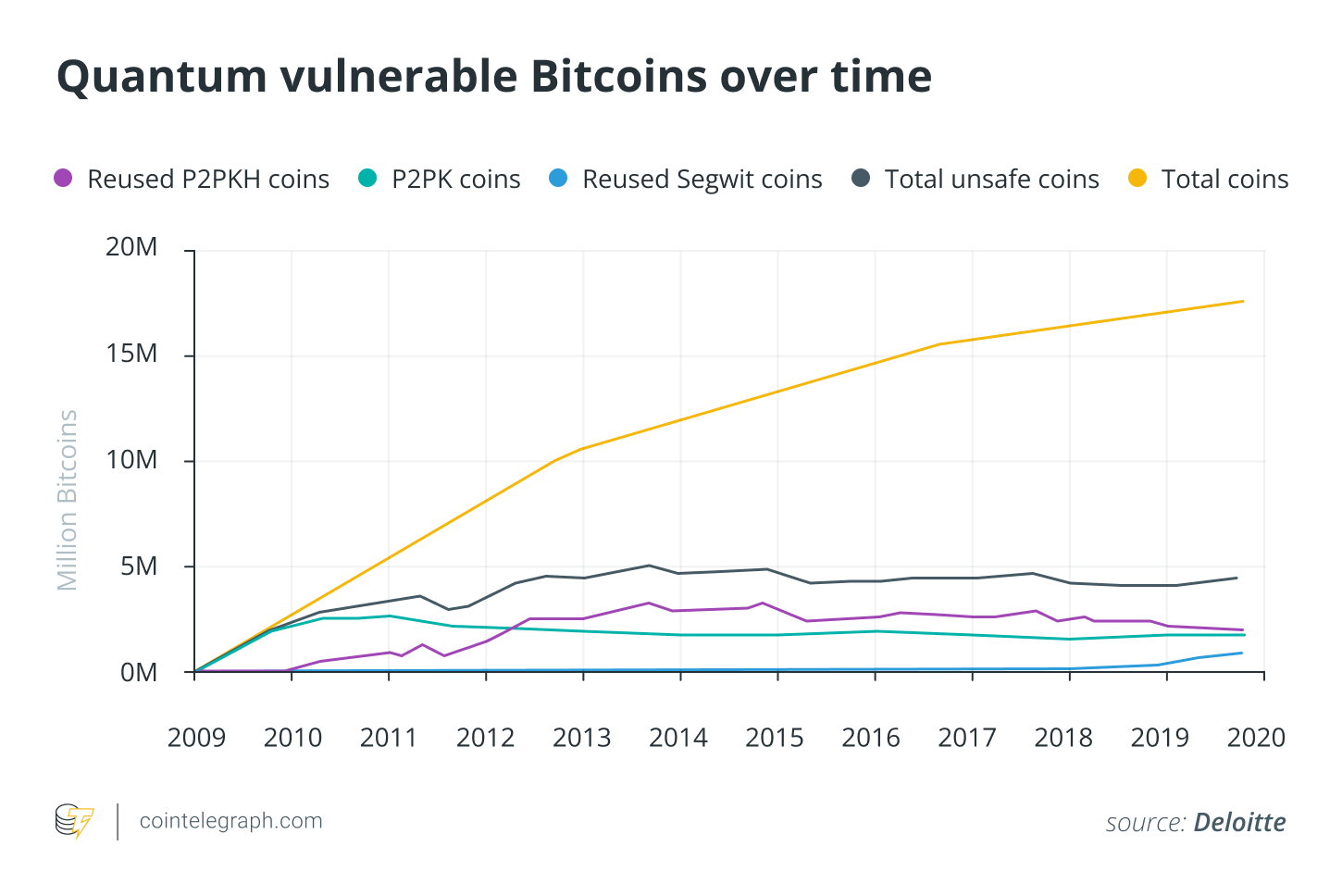
The simple act of moving Satoshi’s coins as proof that an attack was successful would be the case if a hostile actor reached Q-Day first. The act of moving Satoshi’s coins would serve as proof that the fundamental security of Bitcoin had been compromised. It could cause a market panic and a run on exchanges, along with an existential crisis in the crypto-ecosystem.
Did You Know? The most common tactics used by terrorists are: discussed You can learn more about it here. “harvest now, decrypt later.” After acquiring a quantum-computer, malicious actors already record encrypted data such as blockchain public key and internet traffic.
Bitcoin quantum safe protection: How to switch?
All of the tech industry is now moving towards new standards that are quantum resistant. This would mean a network upgrade or a fork to the new algorithm.
Cryptographic communities isn’t waiting to see this happen. This is not the solution. post-quantum cryptography (PQC)A new generation of cryptographic algorithms based on more complicated mathematical problems, which are thought to provide security against quantum and classical computers.
Many PQC algorithms use structures like lattice-based encryption instead of elliptic curvatures. This effort has been led by the US National Institute of Standards and Technology.
-
By August 2024 the National Institute of Standards and Technology (NIST) will have published their first PQC finalized standards.
-
The key one for this discussion is ML-DSA (Module-Lattice-based Digital Signature Algorithm), part of the CRYSTALS-Dilithium standard.
-
OpenSSH 10.0 is being adopted by the wider tech industry. OpenSSH 1.0 will have been adopted by late 2025. made Cloudflare has made a PQC algorithim its default and reported that the majority of their web traffic now is PQC protected.
The path to the future for Bitcoin would almost certainly be through a software upgrade that affects all of its users. This update is likely to take place as a “soft-fork”. The upgrade will introduce quantum-resistant addresses, like the proposed “P2PQC” addresses. No one would be forced to move. Users could instead voluntarily transfer funds to the new, secure addresses from old, insecure ones, like P2PKH and SegWit. It would follow a similar approach to the SegWit upgrades.
“This article is not financial advice.”
“Always do your own research before making any type of investment.”
“ItsDailyCrypto is not responsible for any activities you perform outside ItsDailyCrypto.”
Source: cointelegraph.com


