


Why trust?
Editorial policy that is strict and focuses on accuracy. relevance, impartiality, and relevancy
Created and reviewed by professionals in the field
Reporting and Publishing at the highest level
Editorial policy with a strict focus on accuracy and relevance
Morbi pretium leo et nisl aliquam mollis. Quisque arcu lorem, ultricies quis pellentesque nec, ullamcorper eu odio.
Arthur Hayes is the former BitMEX Chief Executive Officer. In an essay published March 31, he lays out his case for a target Bitcoin price of $250,000 by year’s end. This argument stems from Hayes’ belief that US Federal Reserve effectively surrendered to fiscal dominance, and has resumed quantitative easing for US Treasury market.
It is important to note that the word “you” means “people”. essay, laced with vivid satire and underpinned by rigorous macroeconomic analysis, argues that the Fed’s recent shift in policy signals a structural return to fiat liquidity expansion—an environment historically beneficial to Bitcoin and other hard assets. “Powell proved last week that fiscal dominance is alive and well,” Hayes writes. “Therefore, I am confident QT, at least regarding treasuries, will stop in the short to medium term… Bitcoin will scream higher once this is formally announced.”
QE Returns, Fiat Dies, Bitcoin Flies
Hayes centers his argument on the Federal Reserve’s March FOMC meeting, during which Chair Jerome Powell suggested that balance sheet reduction—or Quantitative Tightening (QT)—would slow considerably. Powell said: “We strongly want the MBS [mortgage-backed securities] to roll off our balance sheet at some point. We would look closely at letting the MBS roll off but keep the overall balance sheet size constant.”
Related Reading
The policy configuration referred to as “QT Twist” Hayes suggests that the Fed will invest MBS runoff into US Treasuries in order to maintain the nominal balance while supporting bond values. Hayes describes this as “treasury QE,” Even if they are not labeled.
“If the Fed balance sheet is kept constant, then they can buy: Max $35 billion per month of treasuries or annualized $420 billion,” Hayes calculated. The tapering down of Treasury QT to 5 billion dollars per month from 25 billion represents a $240 billion annualized increase in dollar liquidity.
Hayes used a dialogue satirical in which Powell was humiliated by Hayes to frame the Fed’s political restrictions. Treasury Secretary Scott Bessent—a fictionalized dramatization that underscores the subordination of monetary policy to fiscal necessity. Bessent, in this dramatized allegory tells Powell: “Next Wednesday at the FOMC I will announce that you’re going to begin tapering my QT and start announcing that QE for treasury bonds The next phase of the project will begin soon. Do you understand?”
Hayes reinforces this point by drawing historical comparisons to Arthur Burns (Fed Chair in the 1970s inflationary years), who acknowledged his admissions in his 1979 address. “The Anguish of Central Banking” Political pressure left the Fed unable to control inflation.
Burns: “The Federal Reserve was itself caught up in the philosophic and political currents that were transforming American life and culture… Monetary policy came to be governed by the principle of under-nourishing the inflationary process while still accommodating a good part of the pressures in the marketplace.”
Related Reading
Hayes says that the situation is similar today. The government’s debt has ballooned and it needs to finance its deficits by lowering the yields.
Trump’s Policy Agenda
Hayes links the Fed’s pivot with the political realities of the second Trump Administration, and in particular its industrial policy objectives. Trump pledged to cut the US deficit by 7% of GDP to just 3% in 2028. He also promised to maintain military spending and avoid cuts to entitlements.
Hayes, however, argues that given the size of debt required, these goals are not mathematically compatible without central bank assistance. “The maths don’t add up unless Bessent can find a buyer of treasuries at an uneconomically high price or low yield. Only US commercial banks and the Fed have the firepower to buy the debt at a level the government can afford.”
To unlock that capacity, Hayes anticipates the Fed will not only halt QT but also exempt banks from the Supplementary Leverage Ratio (SLR)—a key regulatory constraint limiting bank purchases of U.S. Treasuries.
Bessent said that such an action was possible on the All-In Podcast. “If we take [SLR] away… we might actually pull treasury bill yields down by 30 to 70 basis points. Every basis point is a billion dollars a year.”
Hayes believes that Bitcoin has a unique position to profit from the shift in monetary system. Bitcoin has no counterparty risk, and unlike equity, it is not entangled with the political or legal architecture of the government.
“Bitcoin trades solely based on the market expectation for the future supply of fiat,” He wrote. “If my analysis… is correct, then Bitcoin hit a local low of $76,500 We began the journey to $250k by the end of this year last month.
Referencing gold’s reaction to QE1 in 2008–2009, Hayes highlights how liquidity injections can lead to delayed but explosive repricing of anti-fiat assets. In his view, Bitcoin is now playing the same role gold once did—only faster and with more direct global exposure.
Hayes gave insight to Maelstrom’s approach in capital deployment. “We use no leverage, and we buy in small clips relative to the size of our total portfolio,” He said. “We have been buying Bitcoin and shitcoins at all levels between $90,000 to $76,500.”
BTC was trading at $83,500 as of the time this article went to press.
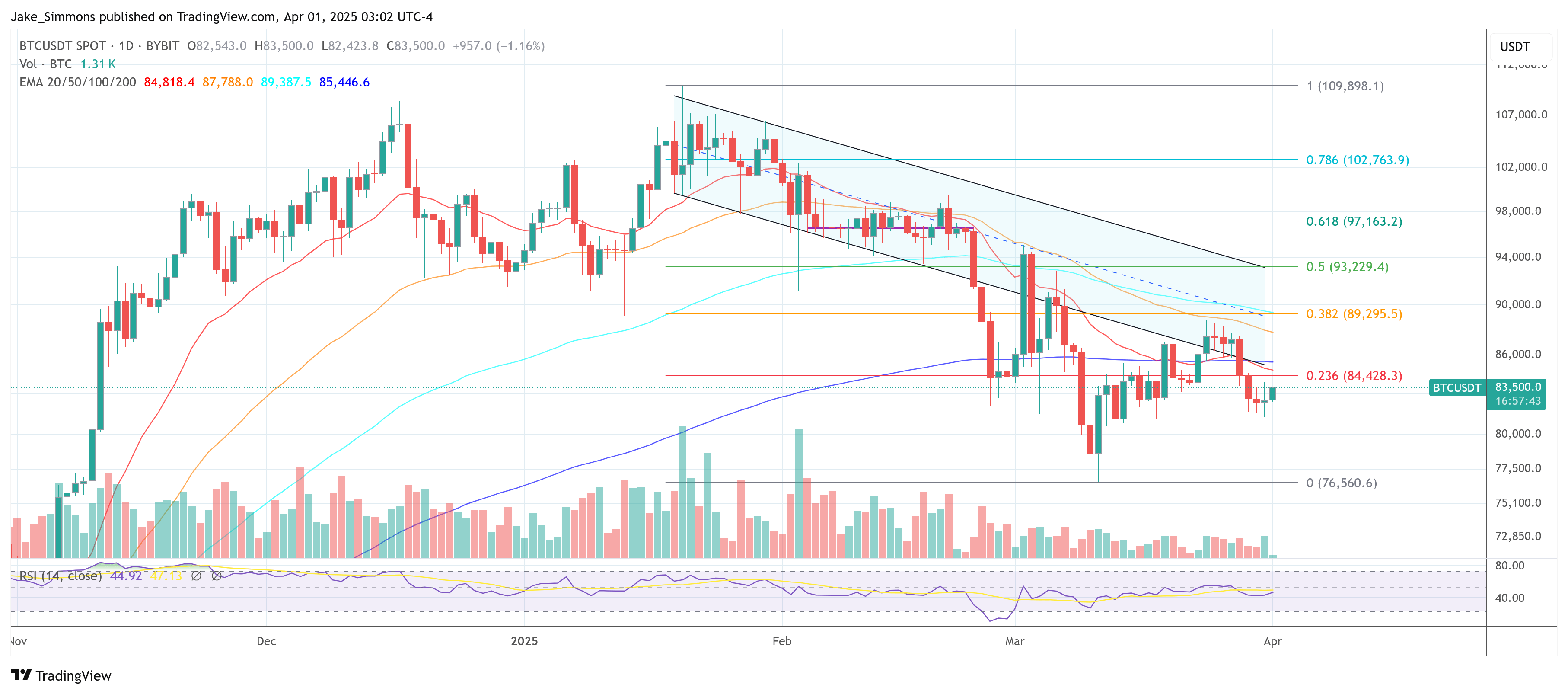
Charts from TradingView.com and YouTube.
“This article is not financial advice.”
“Always do your own research before making any type of investment.”
“ItsDailyCrypto is not responsible for any activities you perform outside ItsDailyCrypto.”
Source: www.newsbtc.com


