


Bitcoin mining can be a difficult business. Before investing in any mining projects, it is important to prospect for the resources. This ensures that all capital will be used to its fullest. Bitcoin is designed to be a secure protocol. This means that miners can’t prospect because finding a “block” is completely random and statistical. As there are only about 144 blocks found each day, it is impossible to predict when a miner will receive their reward, without having significant fluctuations, unless he has an impressive hash rate. For a miner to be able to ensure consistent revenue and minimize variance, they need roughly 1,2% of the hashrate total (approximately ten Exahashes each second as of this writing). CAPEX to reach such hashrates is hundreds of million dollars. If a miner does not have an immense flock of ASICS or is part of a huge enterprise, then he has a serious problem.
This problem was addressed and solved by pool mining. Consider a single mining operator with a relatively small, but still significant operation. Since he only has a fraction of the total network hashrate, it is expected that he will find a block from the 52560 annual blocks. It means he is expected to discover one block per year. He has to pay his electric bill every four weeks. If he waited a year before he got any revenue, he would go bankrupt. This discrepancy of costs and revenue leads him to an interesting idea. A deal is struck with 499 others who run similar operations. In order to avoid everyone mining independently, he proposes that the other miners mine together, as if the were all part of the one company, and split up the rewards based on each miner’s contribution every time a block is found. The 500 miners are collectively expected to be successful in finding a new block around two times per month if each miner holds 1/52560th all of the network’s hashrate. A pool mining strategy ensures that every miner’s hard work and effort will be more often rewarded. Everyone gets paid every month and at the end of the calendar year they all avoided bankruptcy. There are still variances within the same payments.
The pool mining method ensures that miners are paid more often than solo mining. It does not guarantee predictable payouts because it is based on hashing powers. This is known as the luck risk of the pool. Let´s go back to the previous example. Each miner with 1/52560th hashrate is expected to locate 500 blocks within a single year. They may still find 480. They may find 480. Or 497. The pool may not mine 500 blocks exactly in one year. The luck of a pool is calculated by multiplying the blocks mined by the blocks expected based on its total hashrate. A pool that mines 480 when expected to mine only 500 blocks has a 95% luck. The pool’s luck can have a significant impact on earnings in a short period of time. Over time however, this luck evens out, so payouts eventually line up with what is expected, based upon the pool’s average hash rate. The variance of the miners’ payments is affected by two additional factors, the first being the most important. Transaction fees are the first factor. They tend to fluctuate a lot, as seen over the past few years. The transaction fees on the blocks which were mined after the last block halving made up more than 50% for the very first time in Bitcoin’s history. There were several blocks that weren’t full as of the date this article was written (block height 883208), since the mempool had cleared on several occasions in recent days. It’s a big jump for such a small amount of time. Second, the difference in time between the blocks that the network finds is a factor. The transaction fee for a particular block will be lower if a new block is discovered immediately following another. If a longer period of time passes between blocks, then more transactions are broadcast and transaction fees will increase.
Uncertainty can be painful. Particularly when there are substantial amounts of capital on the line. To recoup their significant capital, miners prefer payouts that are more predictable, less volatile, and stable. A Full Pay per Share scheme, paid out by pools, is a solution to this problem. FPPS is a product that works like a conventional insurance. A pure risk transfer. The pool pays the miner based on their expected hashing power, regardless of how many block they find collectively or what transaction fees are paid. All of that risk is assumed by the pool. The predictability of FPPS is unparalleled by other methods. FPPS payouts are the current standard for pools, and no one is surprised.
The FPPS payout scheme isn’t free. Pools need to be well-funded in order to withstand a bad period of luck and the associated risks with FPPS. This high level of capital expenditure costs money. Pools aren’t charitable organisations. The miners end up paying for these high costs through increased pool fees. As we’ve already said, miners must remember that FPPS works like an insurance policy. Insurance policies are dependent on counterparties. Sometimes counterparties don’t honor their obligations when most needed. Miner’s must have faith that pool will meet their obligations under the insurance contract. The risk may be minimal if the size of the pool is large. These pools may also find ways of offloading this risk. Bitcoin is all “about” reducing risk to the counter party, and trying to eliminate it. It looks like Bitcoin’s ethos isn’t yet present in the pool mining part of the protocol.
In addition, any miner who receives FPPS for their work will have to forfeit all revenue associated with transaction fee spikes. The FPPS formula calculates miner reward by analyzing previous transaction fees. Then, Calculating blocks “expected value” For transaction fees. This calculation is then used by the pool to determine how much it will pay to miners in transaction fees. In this way, if transaction fees are on the rise, they will be paid according to the previous payout when the transaction fee spike was not present. In this case, you don’t need to have a Ph.D. in math to know that the rewards go to the pool and not the miners. Even if the number of recent transactions spiked, pool payouts cannot take this into account. This is because the probability that such an increase in transaction volume was not a one-off event is very low. The pools cannot guarantee the spikes in fees will continue to occur. They cannot, therefore, include the fee in payouts to miners without putting themselves at risk of bankruptcy.
Unsustainability in the FPPS Payout Scheme
When we look closely at the FPPS, it’s clear that the scheme was designed to be unsustainable. FPPS will soon collapse as is. Over time, transaction costs will become a larger percentage of total payouts to miners. The inherent variance of transaction fees will increase the payout variance and the overall insurance cost for the FPPS pool. As the Coinbase rewards continue to halve, the reward variance in a block will also increase. The risk associated with providing insurance to miners increases if the variance grows. The premiums will also have to go up. This is because FFPS pool will take on an additional level of risk by sacrificing themselves for a guaranteed payment to the miners. Capital costs increase as risks rise. We will need to wait and see how high pool fees have to go before pools can continue to offer FPPS. Only insurance actuaries are able to determine the exact figure. There is one certainty. Because it’s already expensive, we know that the price will be high.
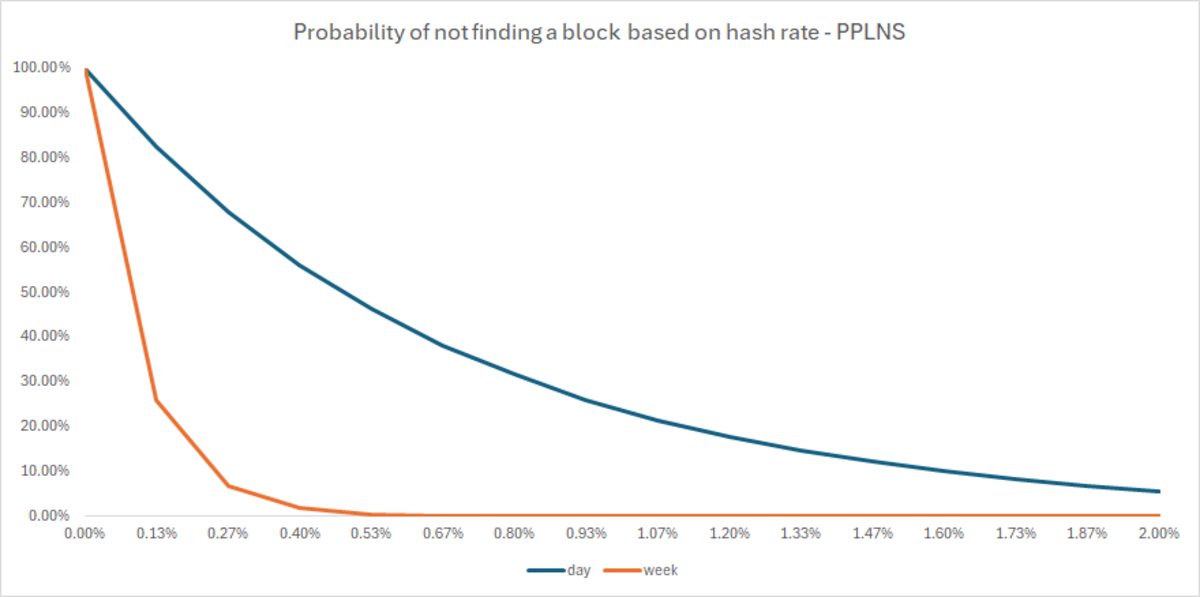
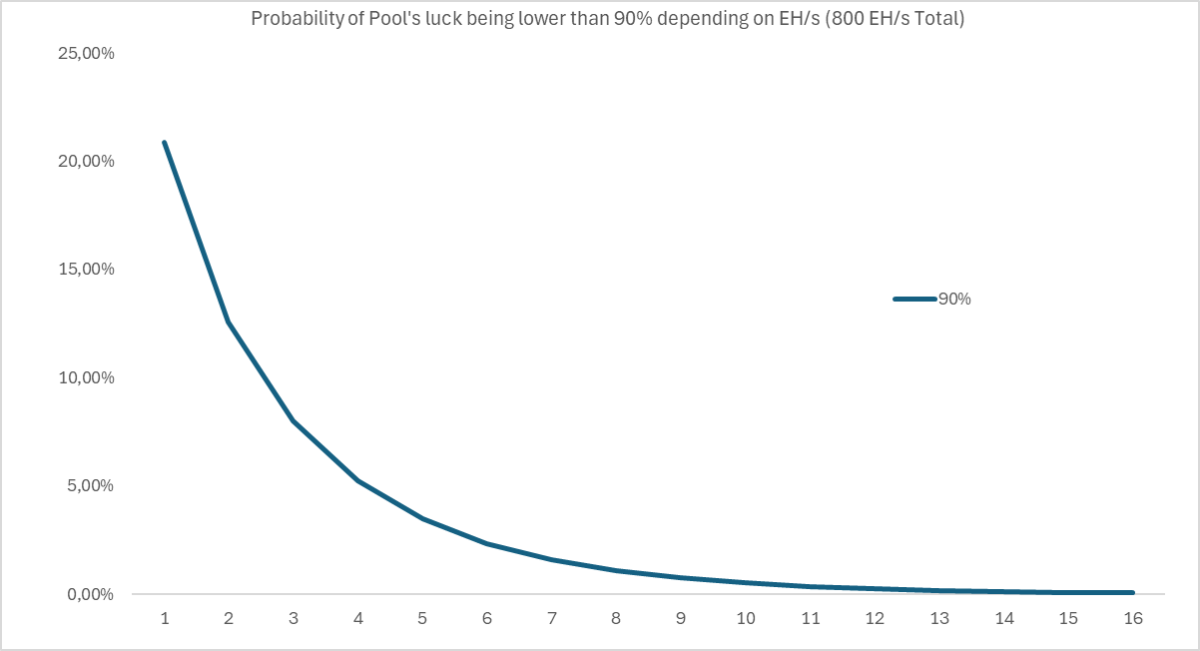
The PPLNS reward system will be more appealing to miners who are trying to maximize profits, because the FPPS method offers a much higher pool charge for predictable and stable payouts. In this scheme, the miners get paid when a pool finds a block. After a block has been found, the pool determines how many valid share each miner had contributed over a time period that includes the N most recent blocks discovered by the pool. It then distributes payouts according to this calculation. The PPLNS time period is also known as this. It is obvious that this method of payment has its drawbacks. There are risks associated with a pool with a luck below 100%, and periods where the pool may not be able to find any blocks. In contrast, a pool which has a hashrate of 1% will only have a 0.0042% probability of failing to find a block in one week. However, the chances of this pool having a luck lower than 90% within the year is approximately 1.9%.
Is there a future market for pool services that offer FPPS at a price high enough to compensate the pool for the entire variance of the block rewards total? There is no way to know. There is one thing that we do know. We know that pool charges will be huge. To eliminate the associated risk of not being paid in a timely and consistent manner, miners must forfeit a large amount of money. Other mature players will enter the Bitcoin mining industry in the future, including energy companies. This means that miners can expect to have access to other risk-management tools on the market. As these tools become more widely available, new innovative payment pool schemes are likely to emerge.
The dynamics described here will have a significant impact on the revenue and profitability of miners. Any miner who wants to increase the profitability of his operation will need to explore alternative payment schemes for pools and strategies that hedge risk. The FPPS method of payout might be useful for miners today. But, as previously mentioned, FPPS’s place in the bitcoin history will be buried soon.
Francisco Quadrio Monteiro is the author of this guest post. Opinions are solely theirs and may not reflect the views of BTC Inc.
“This article is not financial advice.”
“Always do your own research before making any type of investment.”
“ItsDailyCrypto is not responsible for any activities you perform outside ItsDailyCrypto.”
Source: bitcoinmagazine.com


