


DeFi regulation is back in the headlines as the crypto industry and Wall Street disagree on the proposed ‘innovation exemption’ for tokenized assets.
The DeFi Education Fund, an advocacy group for DeFi, announced on the first of April that it would be launching a new website. Writer to the SEC arguing that decentralized protocols should not be ‘misclassified as intermediaries’ like centralized traditional exchanges.
Ayan Dwow, legal counsel at DEF added:
The DeFi tool that provides liquidity, or runs autonomously is not performing an exchange function. Neither the technology nor its developers should be regulated in this capacity.
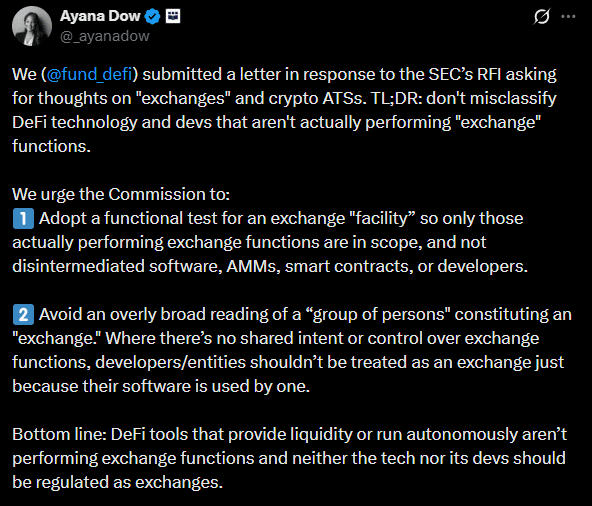
According to the advocacy groupAny non-custodial applications do not fit within the legal definitions of intermediary and exchange. Additionally, classifying developers as intermediaries, yet they don’t control the ‘non-custodial platforms’ they’ve built, would place an overwhelming regulatory burden on them.
Accordingly, this advocacy group has urged that any proposed DeFi regulatory scope excludes disintermediated software (AMMs), smart contracts and non-controlling developer.
Wall Street opposes DeFi’s legal exemption
DEF also responded to SIFMA, the Securities Industry and Financial Markets Association. TradFi, the umbrella group of TradFi, recently suggested that SEC regulate AMMs due to their risk for investor protection.
SIFMA believes that the SEC’s regulation of AMMs, DeFi platforms and other trading systems should be based upon their role in supporting tokenized security trading. DeFi proponents suggest that they should be regulated based on the fact whether or not AMMs are decentralized.
SIFMA is of the opinion that AMMs should be regulated by the Commission to maintain technology neutrality. Based on market function, rather than the protocol architecture.

SIFMA’s position echoed Citadel Securities. Citadel Securities called for strict regulations on DeFi platforms which handle tokenized securities last year.
SIFMA’s and Citadel’s opposition to DeFi unregulated could be genuine concern, considering the scams that have occurred in the past. Wall Street’s compliance rules should be applied to all those who handle tokenized securities.
Citadel’s revenue comes primarily from its role as a central intermediary for retail platforms such as Robinhood. DEF sees Wall Street resistance as motivated by the possible disruption to their business of DeFi Tech (removing intermediaries).
It remains to be seen how the SEC will address these competing interests while still supporting innovation in the upcoming ‘exemption’ framework For tokenized securities.
Final summary
- The DeFi Education Fund, a group that advocates for DeFi users and their rights to privacy, has opposed SIFMA’s efforts to regulate AMMs as well as other non-custodial DeFi platform.
- However, SIFMA claims most ‘decentralized’ platforms pose investor protection risks.
“This article is not financial advice.”
“Always do your own research before making any type of investment.”
“ItsDailyCrypto is not responsible for any activities you perform outside ItsDailyCrypto.”
Source: ambcrypto.com


