


As borrowers reduce their exposure to collapsing market, crypto lending has undergone a reset. Galaxy Research’s report shows that the trend began to show in Q2 when all lending categories fell for the very first time since 2012.
Total crypto-collateralized loans fell 16.78%, shedding $11.33 billion to reach $56.16 billion. Noteworthy, this total has fallen by 40.13 percent from the peak amount of $78.69, showing that interest in borrowing is significantly lower.
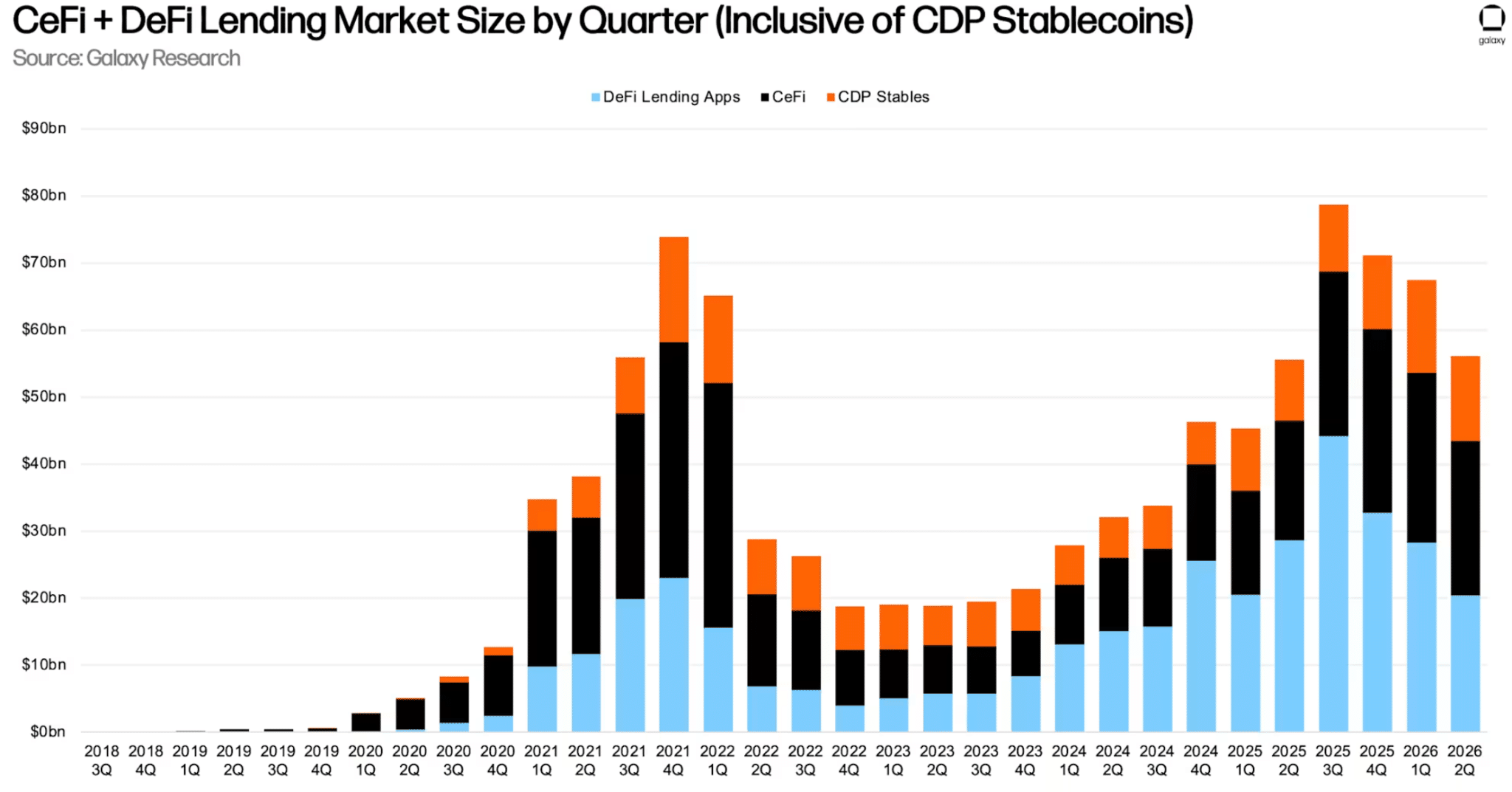
DeFi illuminates this shift even further. The outstanding loan amount was $21.94 Billion in July. This is down from $47.13 Billion in April. DeFi loan amounts are still down by over 80% from what they were in 2025.
Because of this, the borrowing rate continues to drop in waves, even with market tensions and the $200 million exploit rsETH. Deleveraging is taking place through lower credit demand, rather than a widespread liquidation. This leaves a more ordered lending market.
Stablecoin volume reveals lending activity
This lending contraction will be more apparent when we look at stablecoins and how they are moving in the crypto market.
Stablecoins, which have fewer outstanding debts, are estimated to be used by stablecoin exchanges in 2026 for $41.7 trillion of adjusted transfers, leading the way. USD Coin [USDC].
The majority of the USDC movement is still a result of lending operations and liquidity, rather than payment. About 65% of USDC traded volume is made up by flash loans. Ethereum [ETH] blockchain.
Stablecoins are therefore closely linked to automatic borrowing transactions.

Base has similar uses in terms of finance, but 68.91% are from DEX liquid rebalancing while 23.11% come from flash loan.
Because falling loan balances are not a sign of inactivity, the lending industry is still active. In fact, stablecoins have continued to circulate heavily, both as short-term lending and liquidity strategies and longer-term leverage agreements.
Demand for DeFi loans is on the rise
It is more important to ask if the lending boom is translating into increased borrowing by borrowers. DeFi active loans are $23.6 billion. This shows that there is still a demand for DeFi despite broader lending declines.
Nearly half of the population sits on Aave [AAVE]Where $11.2 billion is 47.7% outstanding loans. A recovery in lending headlines could be heavily dependent on the activity of one particular protocol.
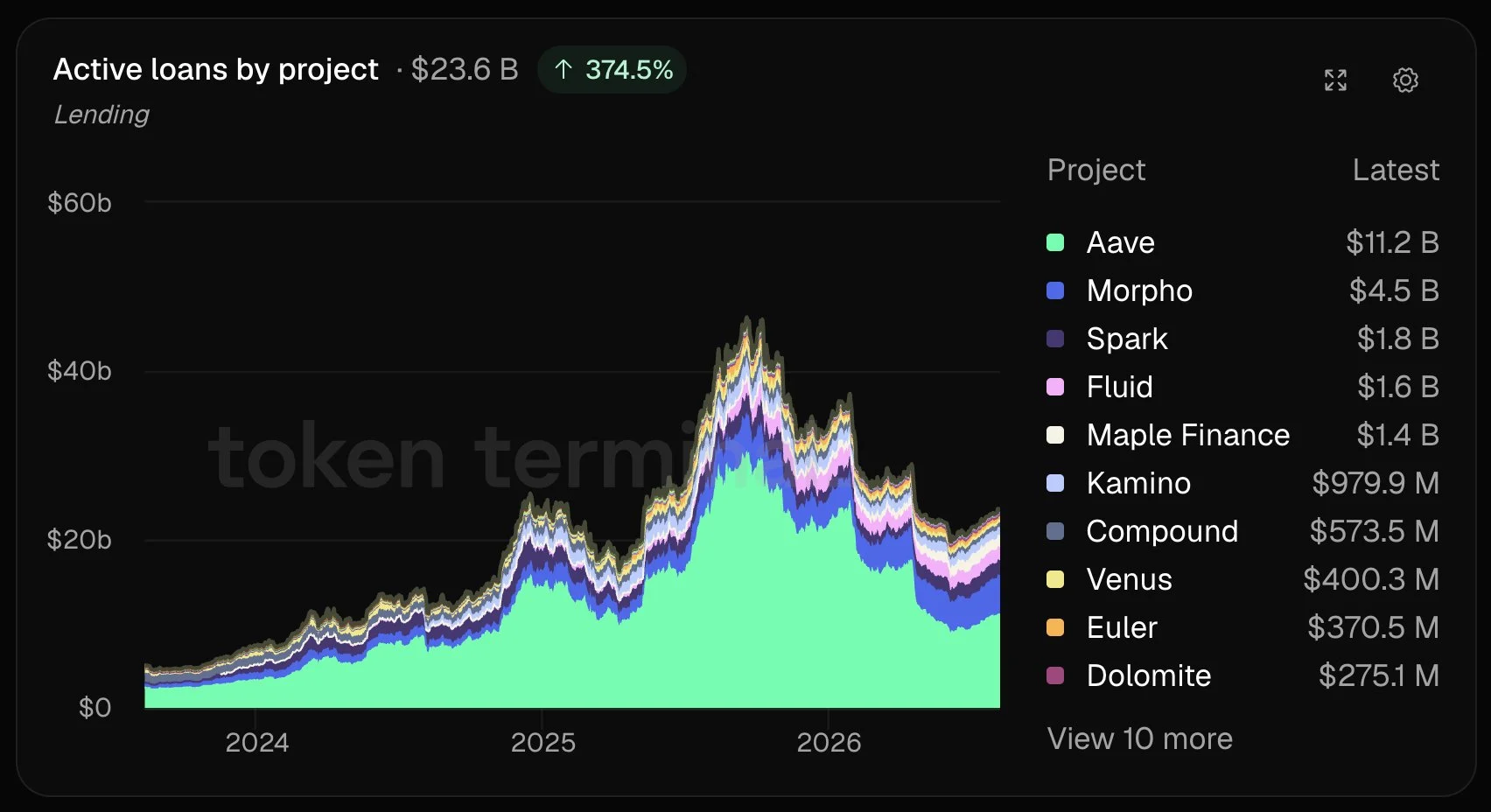
The Token Terminal’s data show that, for the very first time, since AAVE began to decline, monthly average lending has risen to $10,3 billion. This improvement is not enough to confirm greater participation.
It is important to note that if the number of borrowers increases along with outstanding credit, then lending demand will increase. However, With 47.7% active loans concentrated in Aave the recovery is concentrated and not evenly distributed.
Final summary
- USDC shows that liquidity has not decreased despite crypto lending.
- Aave [AAVE] DeFi leads the way in DeFi, but a wider range of borrowers remains important.
“This article is not financial advice.”
“Always do your own research before making any type of investment.”
“ItsDailyCrypto is not responsible for any activities you perform outside ItsDailyCrypto.”
Source: ambcrypto.com


