


Bitcoin’s (BTC( ) The market structure has entered a phase of correction after losing the key level for onchain valuation in late January.
Glassnode shows BTC price compression within the 2024 demand zone, as liquidity conditions ease. BTC supply continues to shift into retail wallets with long-term contracts, while the exchange market has been cooling.
Bitcoin’s price could be influenced by the combination of data from the onchain, technical, and the current capital flow.
Bitcoin’s active supply price dropped, but its holders still defend $66,000
Weekly “The Week On-chain” reportGlassnode reported that BTC’s price decline was due to the fact it fell below its market mean of $79,000 near the end of January. That is where the active supply cost-base lies.
Since then the price has stabilised in an area of $60,000-$69,000 that is being held by long-term investors. This zone is a good support because the coins in this area are older and will last until 2024.
A large group of coins have been accumulating in that age range for more than a full year. They are now close to breaking even. Technically, this supply has tempered any further pressure to sell.
Market Analyst Ardi pointed A similar dynamic is stating X.
“We’re trading inside the same $53-73K range that took 245 days to build last year. Think about how much volume went through this zone. This is the most contested zone on BTC’s entire chart right now.”
Glassnode noted also that deeper bear cycles have gravitated to the realized prices, which are now around $54,900. This metric is used to estimate the average cost of acquiring all coins in circulation.
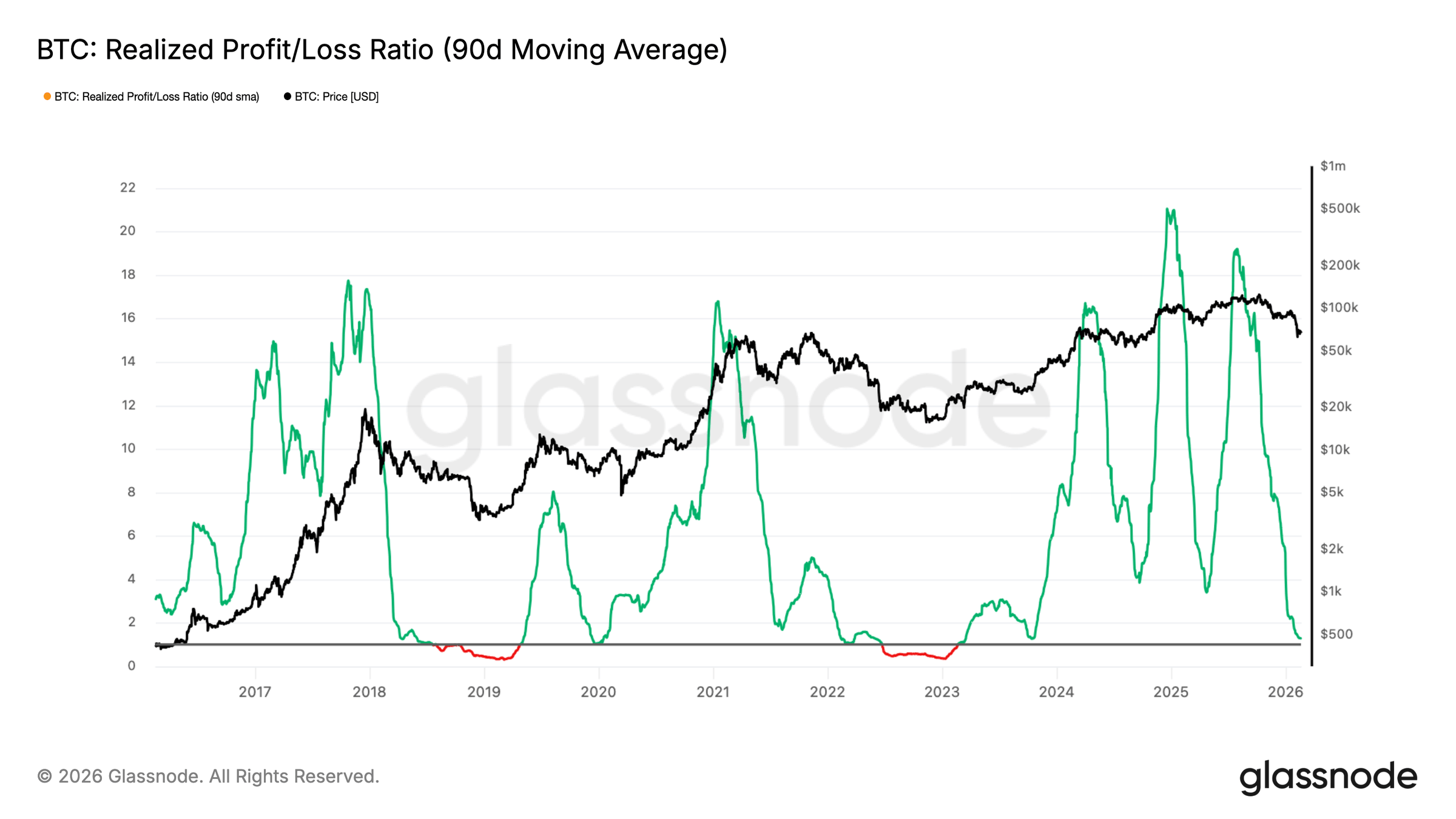
Bitcoin’s liquid conditions remain tight. The 90-day realized profit/loss ratio has declined back into the 1–2 range, a level associated with limited capital rotation. An extended move below 1 is consistent with bearish conditions.
Related: Google searches for ‘Bitcoin going to zero’ at highest since 2022
BTC balances rise despite slowing activity
CryptoQuant data This shows the accumulation of address cohorts’ balances has continued into 2026. The total BTC owned by these cohorts is now over 4,000,000 BTC. This represents a significant increase from the 2,000,000 BTC they held in early 2024.
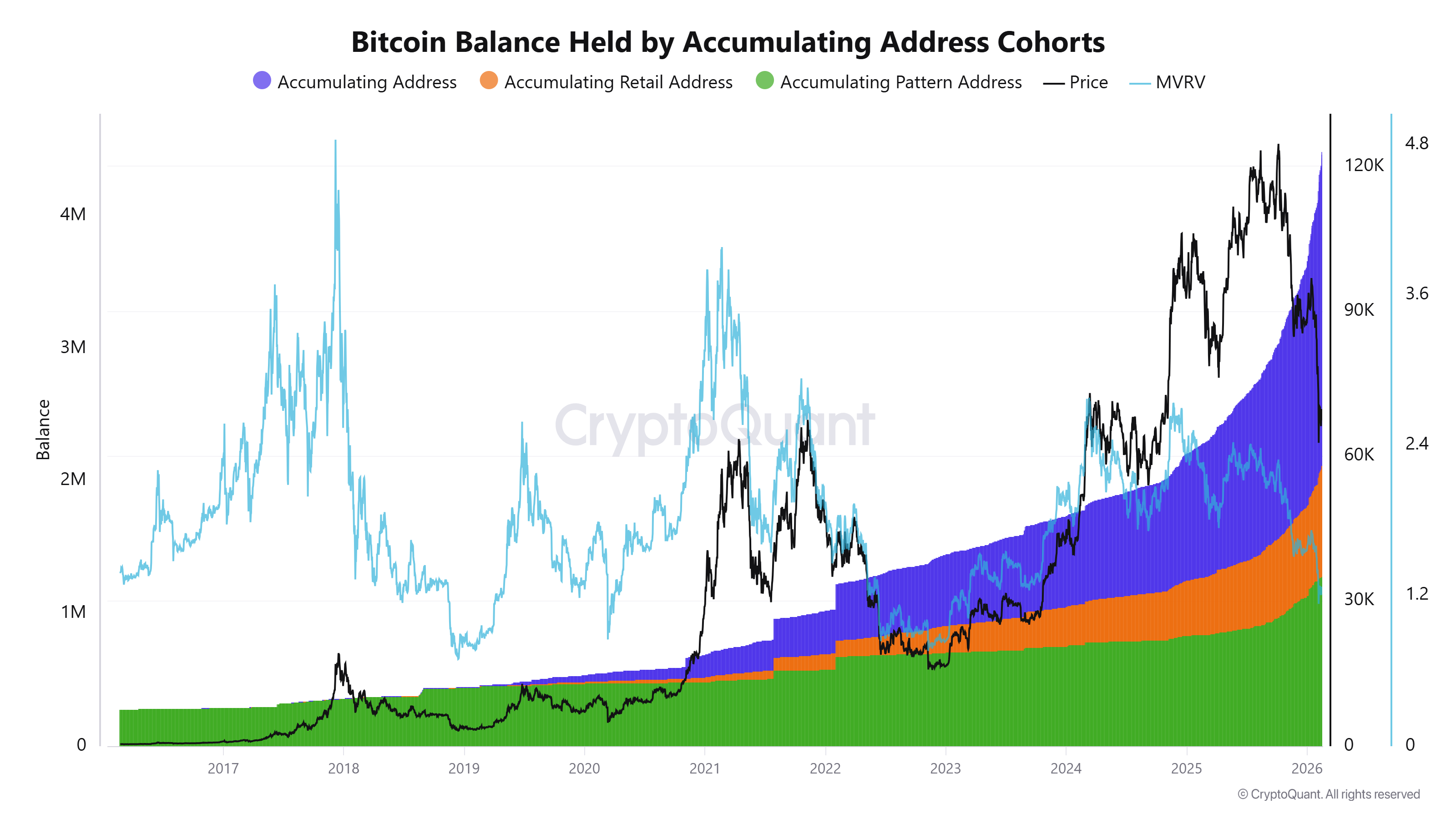
Retail-linked accumulation wallets have grown by 850,000 BTC. Meanwhile, the pattern wallets that add BTC at regular intervals and with little outflows have grown to 1,27 million BTC. This growth occurred even when the price of bitcoin dropped by 2026.
The inflows of funds from addresses that are part of a centralized exchange and addresses with high activity have remained relatively stable. In contrast to the expansion phase of 2023-2024, when inflows spiked frequently above 1.2-1.5 million BTC, recent activity is significantly lower. It averages around 300,000.0-400,000 BTC.
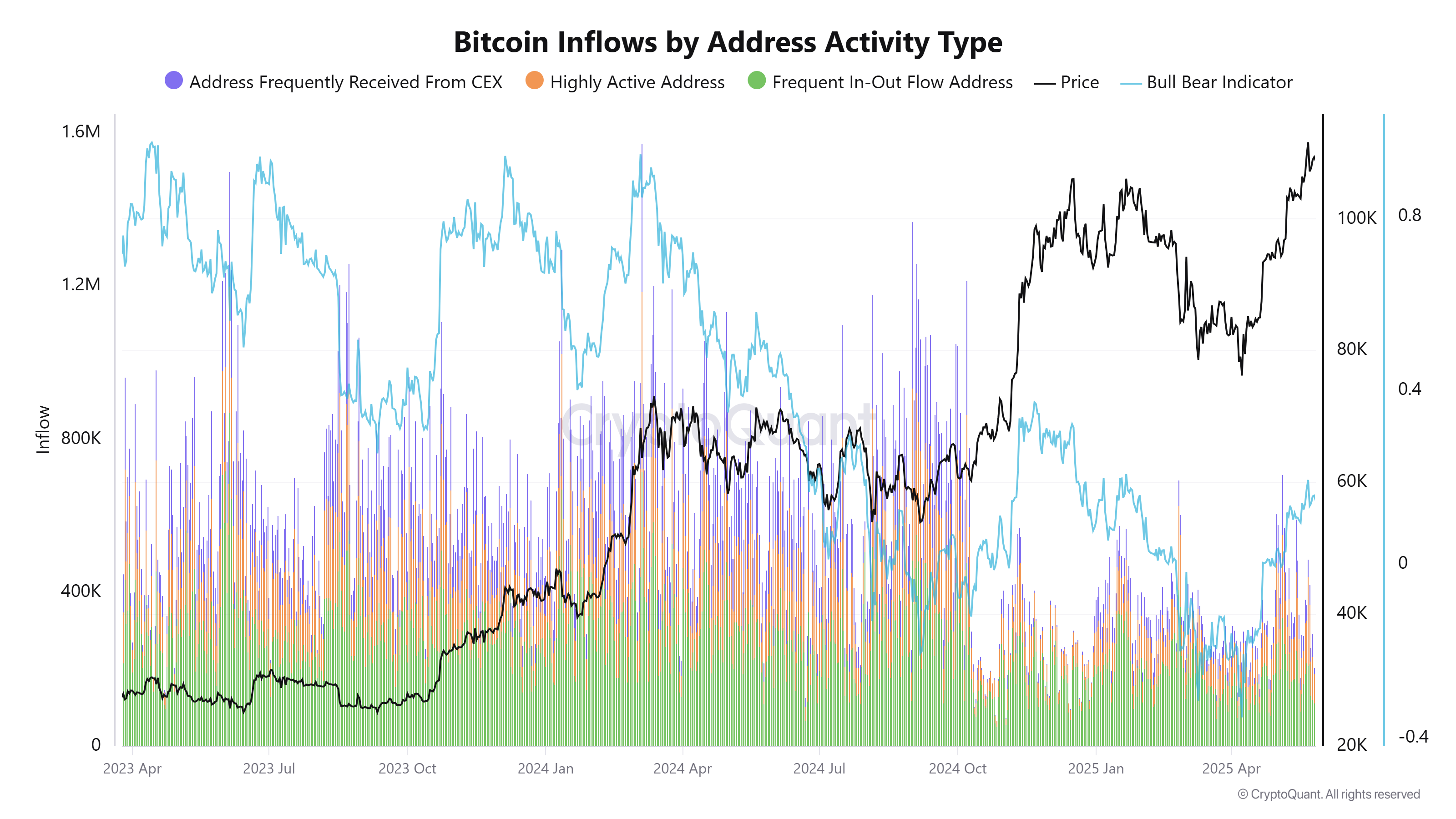
Divergence between the two shows more BTC being placed in wallets for long term storage, and fewer coins moving around major exchanges. This reduces liquidity and slows short-term trade activity.
Related: Bitcoin’s consolidation nears ‘turning point’ as $70K comes in focus: Analyst
The article is not intended to provide investment advice. Risk is inherent in every investment decision and trade. The reader should always do research prior to making their decisions. Cointelegraph strives to deliver accurate, timely and reliable information. However, Cointelegraph cannot guarantee that the information contained in this article is complete, accurate, or reliable. The article could contain statements which are forward-looking and subject to risk. Cointelegraph shall not be responsible for any damage or loss resulting from reliance on the information.
“This article is not financial advice.”
“Always do your own research before making any type of investment.”
“ItsDailyCrypto is not responsible for any activities you perform outside ItsDailyCrypto.”
Source: cointelegraph.com


