


Why trust?
A strict editorial policy that emphasizes accuracy, relevancy, and impartiality
Expertly crafted by experts in the industry and thoroughly reviewed
Reporting and Publishing at the highest level
A strict editorial policy that emphasizes accuracy, relevancy, and impartiality
Morbi pretium leo et nisl aliquam mollis. Quisque arcu lorem, ultricies quis pellentesque nec, ullamcorper eu odio.
Singapore’s QCP Capital started its note on Monday with a direct assessment. “Implied vols continue to come under pressure, with BTC stuck in a tight range as summer approaches.” The options house believes that the market will drift into the holiday season in the Northern Hemisphere much like it did last year, when the volatility of one-month ATM fell from 80 vols to 40 vols and then spot again. “failed to decisively breach the $70k level.” This year, the difference is the higher level: BTC was between $100,000 to $110,000 during the majority of the last three weeks.
Deribit’s screens of options aren’t the only thing that shows calm. Deribit’s DVOL index, which tracks 30-day implied volatility, is hovering just above 40—one of its lowest prints in more than two years. Even though implied volatility has been quieter than expected, it is still a good sign that the one-year lows are still impressive. “optically rich,” QCP argues. That valuation gap has encouraged traders to sell gamma: perpetual open interest has slipped and the favourite hedge-fund basis trade—long spot via the new ETFs, short futures—has unwound, taking what QCP calls “the natural bid for vol” Out of the Market
Read Related Articles
The listed option market flows confirm this malaise. Dealers have reported that gains of $130,000 to $140,000 in July are now being extended into September “in meaningful size,” Effectively pushing the bullish timelines down further. Meanwhile, Deribit’s put-skew has flattened as short-dated hedges expire worthless—a dynamic that often precedes a directional move once macro catalysts arrive.
This week could break Bitcoin’s Lull
These catalysts are uncomfortably near each other. The Bureau of Labor Statistics is scheduled to release May’s consumer price data on Wednesday. The headline CPI for April rose by a modest 0.2% from month to month, and 2.3% on an annual basis. Core prices increased 0.2% in the same period and 2.8% over the past year.
The economists expect the headline CPI will accelerate to 0.3% for the month, and to 2.5% on an annual basis. Core CPI is expected to increase to 0.3% respectively. On Thursday, producer prices are expected to follow: the April PPI was down 0.5% for the month but still posted 2.4% over the year. According to consensus, May’s PPI is expected to increase by 0.2%. The annual rate will still be near 2.4%.
Not only is inflation a macro factor, but it’s also a major one. Friday’s stronger-than-expected US non-farm payrolls report—139,000 jobs versus a 130,000 consensus—rekindled dollar strength and knocked gold more than one percent lower, but BTC “remained conspicuously unmoved,” QCP is noted. This morning, the same divergence can be seen: US equity Futures are a little softer. spot gold is bid On the basis of demand for safe havens, bitcoin’s price is virtually unchanged.
The geopolitical situation may be the catalyst that ignites inflation. Today (Monday), senior US and Chinese officials met in London to push for what they both call a limited deal on trade that would reduce export control threats and retaliatory duties.
The talks matter for crypto because tariffs have been feeding directly into the CPI basket and—via global risk sentiment—into bitcoin demand. “A clean break below $100k or above $110k would likely reawaken broader market interest,” QCP writes “but we currently see no obvious near-term catalyst to drive such a move.” A single headline could completely change the equation.
Read Related Articles
The institutional positioning also hints fatigue. US regulatory filings indicate that the largest hedge funds in America have reduced their stakes.pot-ETF holdings In the first quarter, the spread between cash and carry was reduced. Net inflows across the 11 US bitcoin ETFs have slowed to a trickle since late May, leaving cumulative additions at roughly $44 billion—unchanged for almost a fortnight, according to Farside data.
For now, the market’s centre of gravity is exactly where QCP says it is: inside the $100,000–$110,000 corridor. The premium for volatility sellers continues to grow, while the reward-risk ratio of momentum traders has remained poor. With CPI, PPI, and high-stakes negotiations falling within a 72 hour window, option writers’ premiums could look paltry.
In the event that the inflation figures surprise you to the positive, then a repricing is likely. Fed-cut expectations Bitcoin could fall below the six-figure mark for the first since April, as a result of a wobble in risk appetite. In the opposite scenario, even a small easing in tariffs could change the story. “soft landing, structural bid via ETFs,” Re-ignite topside options into the quarter end of June. The September $140,000 call options could be activated much sooner than buyers expect.
Bitcoin’s Summer Doldrums are on their way out. “Without a compelling narrative to spark the next leg higher, signs of fatigue are emerging,” QCP warns. The narrative candidates arrive this week; whether they supply ignition or simply more noise will decide whether 2025’s range trade breaks—or cements itself as the dominant theme of another crypto summer.
BTC is currently trading for $107,919.
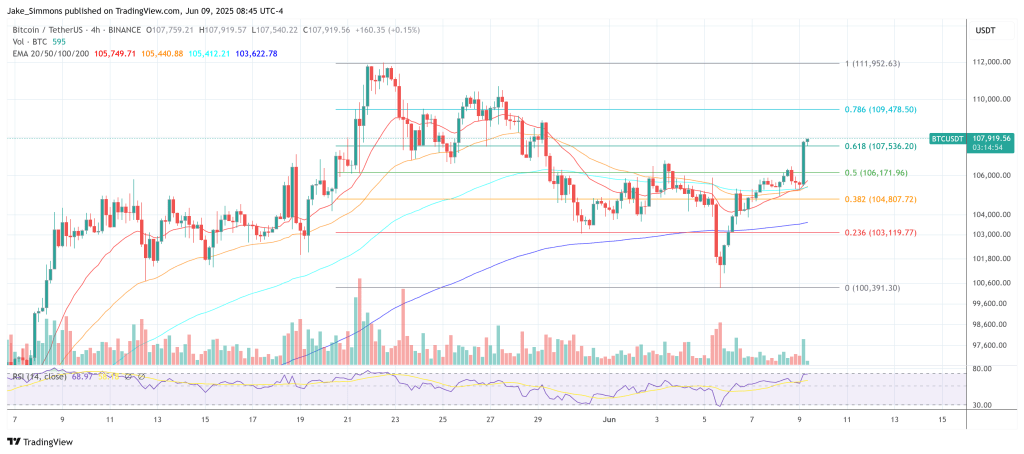
Featured Image created using DALL.E and chart from TradingView.com
“This article is not financial advice.”
“Always do your own research before making any type of investment.”
“ItsDailyCrypto is not responsible for any activities you perform outside ItsDailyCrypto.”
Source: www.newsbtc.com


