


Ethereum’s native token, Ether (ETH), dropped to a year-to-date low of $1,927 on Thursday, and is currently down more than 60% from its all-time high of $4,950.
Analysts say the drop is a stress test for holders, while onchain data and cryptocurrency exchange inflows point towards the beginning of a downturn. Despite selling, a group of Ether owners has bought, though it is still unclear whether they will be able to help ETH regain $2,000 in the future.
Key takeaways:
-
Mid-sized holders (100–10,000 ETH) reduced their holdings, signaling a capitulation phase.
-
Large holders (10,00 ETH and above) have increased their exposure over the last three months, which has helped to absorb the sell-pressure for altcoins.
-
ETH has been trading at a lower price than the actual realized price of the altcoin for the last quarter. Rising exchange flows also increase the risk.
Onchain data shows who’s holding, adding and capitulating
Over the past five months, the Ether balance-by-holder-value data shows a clear change in behavior across different wallet sizes.
It reveals who is absorbing the downside pressure while others are exiting when prices are returning to levels of May 2025.
Data from CryptoQuant noted that on August 18, 2025, wallets holding 100–1,000 ETH controlled 9.79 million ETH, 1,000–10,000 held 14.51 million ETH, 10,000–100,000 held 17.18 million ETH, and 100,000-plus wallets held 2.75 million ETH.
On Wednesday, the balances of the 100–1,000 and 1,000–10,000 cohorts fell to 8.32 million ETH and 12.26 million ETH, respectively.
In contrast, 10,000–100,000 wallets increased holdings to 19.77 million ETH, while 100,000-plus wallets expanded to 3.68 million ETH.
Data showed that whales and larger entities were accumulating, while small and medium-sized holders appeared to be spreading into the current weakness.
Ether trades also below the realization price for each cohort. The realized price reflects average cost-basis at which every group has last sold its ETH. Realized prices cluster between $2,120 for 100,000-plus holders and $2,690 for 100–1,000 holders, with ETH briefly closing below the aggregate realized price of $2,630 on Saturday, a level linked with stress-driven selling.

Related: Ethereum price: Classic chart pattern puts sub-$2K ETH in focus
Exchange inflows and taker data keep pressure on ETH’s price
Ether exchange inflows on Binance surged to about 1.63 million ETH on Wednesday, the highest daily reading since 2022. Inflows of large amounts may be a sign that investors are preparing to sell, or they could indicate rebalancing. A spike in inflows during a period with weaker price movement is also causing concern.
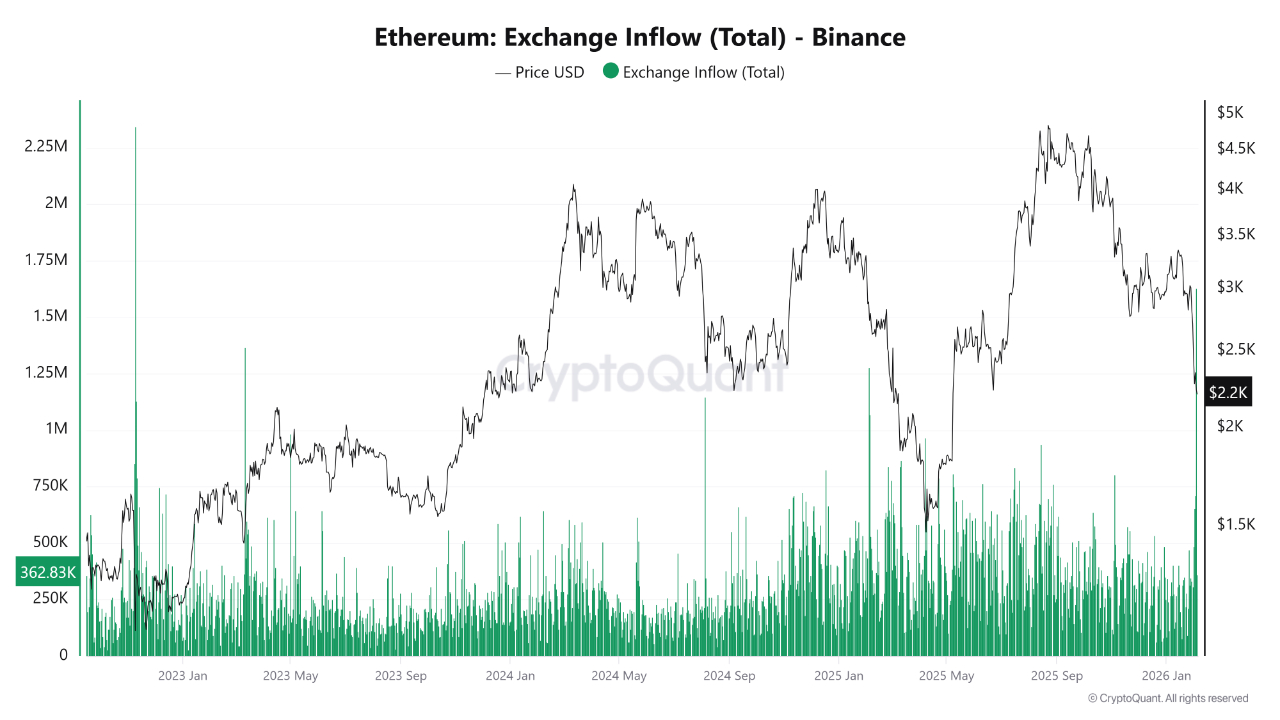
Market execution data adds to that picture. Crypto analyst PelinayPA noted that Ether’s Binance taker buy/sell ratio sits “around 0.94,” below the neutral level of 1. The 30 day and 50 days averages are both below 1, indicating that selling pressure has been the predominant trend, not a phase.
PelinayPA added that this may also mark the beginning of a “true bear season” for the altcoin, expecting difficult price conditions to persist for a while longer.”

Related: Vitalik Buterin sells $6.6M in ETH after flagging planned withdrawals
This article contains no investment recommendations or advice. Risk is inherent in every investment decision and trade. The reader should always do research prior to making their decisions. Cointelegraph, while striving to give accurate information as quickly as possible, does not warrant the accuracy, reliability, or completeness of this information. The article could contain statements which are forward-looking and subject to risk. Cointelegraph is not responsible for loss or damages arising out of your reliance upon this information.
“This article is not financial advice.”
“Always do your own research before making any type of investment.”
“ItsDailyCrypto is not responsible for any activities you perform outside ItsDailyCrypto.”
Source: cointelegraph.com


